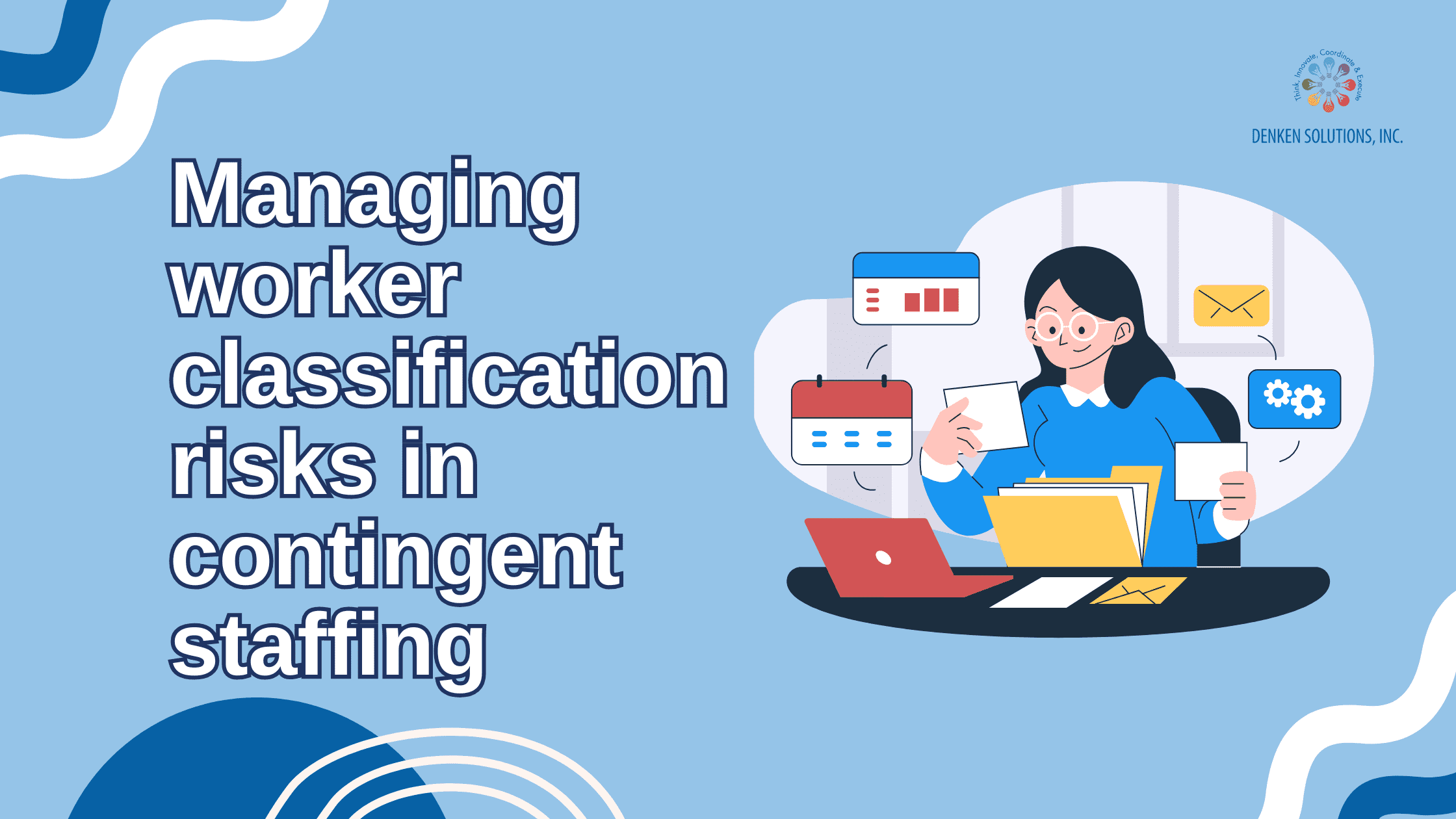
Contract and temporary staffing help businesses stay flexible and scale quickly. However, they also come with worker classification risks. When a worker is misclassified as a contractor or temporary worker rather than an employee, it can result in compliance issues, legal trouble, and penalties.
Since labor laws vary by location and are strictly enforced, even minor classification errors can lead to significant problems.
Therefore, understanding worker classification is essential for businesses that are using contingent talent models. When supported with clear contracts, ongoing oversight, and proper documentation, companies can protect themselves while maintaining the flexibility that contract and temporary staffing are designed to deliver.
What is worker classification?
Worker classification is the process of determining how a worker is legally categorized by a company, such as an employee, independent contractor, or temporary worker. This classification will define the company’s responsibilities related to payroll, benefits, labor laws, compliance, and taxes.
The classification is based on how the work is performed rather than what is just written in the contract. Factors such as the level of control over the worker, the duration of engagement, the type of work, and the degree of independence all influence the appropriate classification. Proper worker classification helps businesses remain compliant, avoid legal risks, and manage their workforce responsibly.
Why is classification risky in temporary staffing?
Worker classification can be risky in temporary staffing, as temporary workers often act like regular employees, even if they aren’t classified as such. This creates compliance challenges when legal definitions are not followed carefully.
Some of the key reasons classification risks are higher in temporary staffing are:
- Increased level of control: Temporary workers might follow fixed schedules, work under company policies, and receive direct supervision.
- Overlap in roles: Temporary workers often perform core business functions similar to those of full-time employees.
- Extended assignments: Short-term roles usually turn into long-term engagements without reclassification.
- Operational integration: Using company systems, internal processes, and tools increases employee dependency.
- Assumption-based classification: Businesses can rely on staffing labels rather than legal criteria.
Since labor authorities assess how work is usually performed, not how it is labeled, these factors can easily result in misclassification. Without strong compliance oversight, temporary staffing can expose businesses to financial, legal, and operational risks.
Explore navigating ethics in contingent staffing to learn how ethical workforce practices reduce risk and improve transparency.
Common instances of worker misclassification in contingent staffing
Worker misclassification occurs when contingent workers are treated as employees, even though they are hired as temporary staff or contractors. Ensuring proper worker classification is essential for maintaining IRS compliance and avoiding costly penalties. Given below are the most common instances where risks of misclassification can arise:
1. Fixed working hours:
Contingent workers are required to follow standard business hours or stick to a fixed attendance tracking system. This creates risk since independent contractors are expected to control how and when they perform their tasks. Enforcing a fixed number of hours can demonstrate employer control, which can be a key indicator of employment.
2. Long-term engagement:
If a contingent worker continues working for the organization for multiple years without any defined project timeline or renewal-based contract can result in misclassification. This is primarily because this signals permanent employment.
3. Performing the primary business functions:
If the contingent worker performs similar duties as full-time employees, such as finance support, production roles, core IT operations, and customer service, it can result in the possibility of misclassification.
4. Supervision and managerial control:
If the contingent employer is reporting directly to a manager, participates in internal team meetings, follows the internal workflows, and receives daily task assignments, it can be a major factor used to determine employment status.
Impacts of misclassifying workers
Misclassifying workers can result in serious consequences for businesses. This affects the legal compliance, finances, and overall operations. What might seem like a small misclassification error can quickly turn into a costly and disruptive concern.
The key impacts of worker misclassification include the following:
- Heavy legal penalties and fines: Non-compliance with labor and employment laws can result in government penalties and enforcement actions.
- Back wages and benefits: Businesses might be required to pay unpaid salaries, benefits, overtime, and statutory contributions.
- Tax liabilities: Incorrect classification can trigger interest charges, penalties, and tax reassessments.
- Litigation and audit risk: Misclassification usually leads to employee claims, lawsuits, and labor audits.
- Operational disruption: Investigations and corrective actions consume resources, time, and management focus.
- Reputation damage: Violations of compliance standards can harm employer branding and stakeholder trust.
Proper worker classification helps organizations avoid these risks while maintaining a compliant and sustainable staffing model.
Key factors used to determine classification
Worker classification is determined by how the working relationship operates in practice, not just by contract terms. Labor authorities assess various factors to determine whether a worker is an employee, a contractor, or a temporary worker.
Common factors that are used to determine classification include the following:
- Level of control: The company should establish who decides how, when, and where the work is being done.
- Nature of work: Whether the role is part of the company’s core business operations.
- Duration of engagement: Classification also depends on whether it’s short-term and project-dependent work or an indefinite assignment.
- Management and supervision: Degree of oversight, reporting structure, and performance tracking.
- Tools and resources: Whether the worker uses company-provided equipment, systems, and workspace.
- Exclusivity: Whether the worker is free to work for multiple clients or is dependent on one company.
- Payment structure: Fixed salary versus project-based or milestone-based payments.
No single component determines classification; instead, several elements are assessed collectively. As roles and responsibilities change, regular evaluations help ensure continued compliance.
How to reduce worker classification risks?
Reducing worker classification risks requires a proactive, compliance-first approach to handling contract and temporary workers. Businesses have to focus on how work is structured, documented, and managed throughout the engagement.
The best practices to reduce classification risks include:
- Begin by clearly defining roles: outline job responsibilities, engagement terms, and the scope of work from the start.
- Using compliant contracts: Ensure the agreements reflect the actual working relationship and comply with local labor law requirements.
- Limit supervision and control: Avoid treating contractors or temporary workers as if they were full-time employees.
- Monitor engagement duration: Regularly review long-term or recurring assignments for reclassification purposes.
- Conduct periodic audits: Reassess worker classification as responsibilities, roles, or business needs change.
- Train managers: Educate internal teams on proper handling of contract and temporary workers.
Organizations may reduce operational, financial, and legal risks while maintaining flexibility by incorporating compliance into labor planning.
How does Denken Solutions assist in preventing worker misclassification?
Denken Solutions plays a vital role in helping businesses avoid worker misclassification by following a staffing approach that aligns with compliance across contract and temporary workforce models.
We ensure that every worker engagement is structured correctly from the beginning. This is based on role scope, level of control, duration, and applicable labor laws. Our team carefully aligns payroll processes, contracts, and workforce management practices with legal classification requirements to reduce risk exposure.
Denken Solutions supports compliant staffing by doing the following:
- We clearly define the roles, responsibilities, and engagement terms of the workers
- Ensure contracts reflect the actual working relationship
- Manage payroll, documentation accurately, and statutory compliance
- Reduce co-employment and classification risks via structured processes
- Constantly monitor engagements to address changes that can impact classification
By handling compliance, oversight, and workforce administration, Denken Solutions enables businesses to leverage contract and temporary staffing with confidence without any legal, financial, or operational risks of worker misclassification.
Conclusion:
Worker classification is an essential requirement for contract staffing compliance. When workers are misclassified, businesses can face legal exposure, financial penalties, and operational disruptions that can affect long-term stability. As workforce models tend to become more flexible, the risk of misclassification increases. This is especially true when roles, responsibilities, and engagement terms are not clearly defined or reviewed regularly.
By understanding classification risks and adopting a compliant approach to work, businesses can protect themselves while also benefiting from temporary staffing. Partnering with an experienced staffing provider like Denken Solutions ensures proper classification, ongoing compliance, and reduced risk, enabling businesses to scale their workforce with control and confidence.