In the current business scenario, one strategic imperative that comes to the fore is the creation of a blended workforce by merging full-time employees with freelancers, independent contractors, or part-time workers. Enterprises with blended workforce strive to combine traditional workforce approaches with a contingent staffing model to achieve maximum productivity and agility, remaining at par in changing times. This article will help you better understand the benefits of developing a blended workforce for modern businesses and give you some key points to consider when your organization combines its traditional employee base with contingent staff.
The Emergence of Contingent Workforce Strategies
Accelerated by factors like technological advancements, remote work norms, and the rise of the gig economy ever since the COVID-19 pandemic, freelancers, temporary workers, and independent contractors have come to the fore in every industry. Before the pandemic, contingent workers were often only hired by companies to backfill a position for a certain time period. However, many companies now strategically leverage contingent workers to build blended teams that remain flexible and scalable, even during economic uncertainties.
According to a report by Gartner, nearly 50% of organizations plan to expand their use of contingent workers over the next few years, which emphasizes the growing importance of contingent workforce strategies. Companies that do this effectively can stay agile and resilient in the face of business and economic changes.
Advantages of a Blended Workforce Model
Here are the top advantages of adopting a blended workforce model:
Agile Workforce and Scalable Operations
A blended workforce introduces the possibility of infusing agility into teams, using contingent workers to serve businesses on demand. In other words, blended workforce help businesses acquire flexibility, enabling easier scaling during seasonal highs or increased workloads. The ability to quickly scale the contingent workforce further helps reduce hiring time and overhead costs like physical office space. Additionally, a blended workforce model reduces the risk of mass layoffs during economic downturns, helping organizations remain nimble.
Acquisition of Specialized Talent
By integrating contingent workers with full-time hires, companies can address project-specific needs more effectively. If a project requires a skill set that your current team lacks, a blended workforce allows you to bring in a contractor with the expertise needed without committing to a permanent hire. Contingent workers tend to possess highly specialized, project-specific skills that complement the competencies of full-time employees.
Maintain Cost-Efficiency
Contingent workers do not require the same long-term commitments as full-time employees. Employers only pay for their services on a project basis, which can be more cost-effective than hiring full-time staff for short-term needs. This arrangement enables companies to focus on essential business functions, engaging full-time employees in core operational tasks while leveraging contingent workers for specific projects.
Promotion of Diversity and Innovation
The inclusion of contingent workers in teams with full-time employees fosters a diverse, inclusive workplace culture. This collaborative environment encourages innovation, as a mix of perspectives can drive fresh ideas and creative solutions. A blended workforce model often brings new viewpoints and expertise to the table, helping businesses stay ahead in competitive industries.
Acceleration of the Talent Acquisition Process
Using staffing agencies that offer temp staffing solutions allows companies to bypass traditional hiring processes, saving valuable time. Blended teams are often set up much more quickly, as the staffing agency handles the screening, onboarding, and training of the contingent workers. This approach is particularly useful for businesses that need to quickly scale their workforce or address immediate skill shortages.
Reduction of Workforce Overhead
Integrating contingent workers reduces overhead costs typically associated with full-time staff, such as health benefits, retirement schemes, and paid leave. This creates significant cost savings for businesses, allowing them to allocate resources more efficiently across their workforce.
Mitigate External Risks
In times of economic uncertainty, a blended workforce model can help mitigate risks. By relying on contingent workers, businesses can more easily adjust their headcount in response to external challenges, without the need for mass layoffs. This flexibility can be particularly crucial during financial downturns, as it helps businesses keep their operations intact while managing costs.
Key Considerations for Blending Contingent Workforce with Full-Time Teams
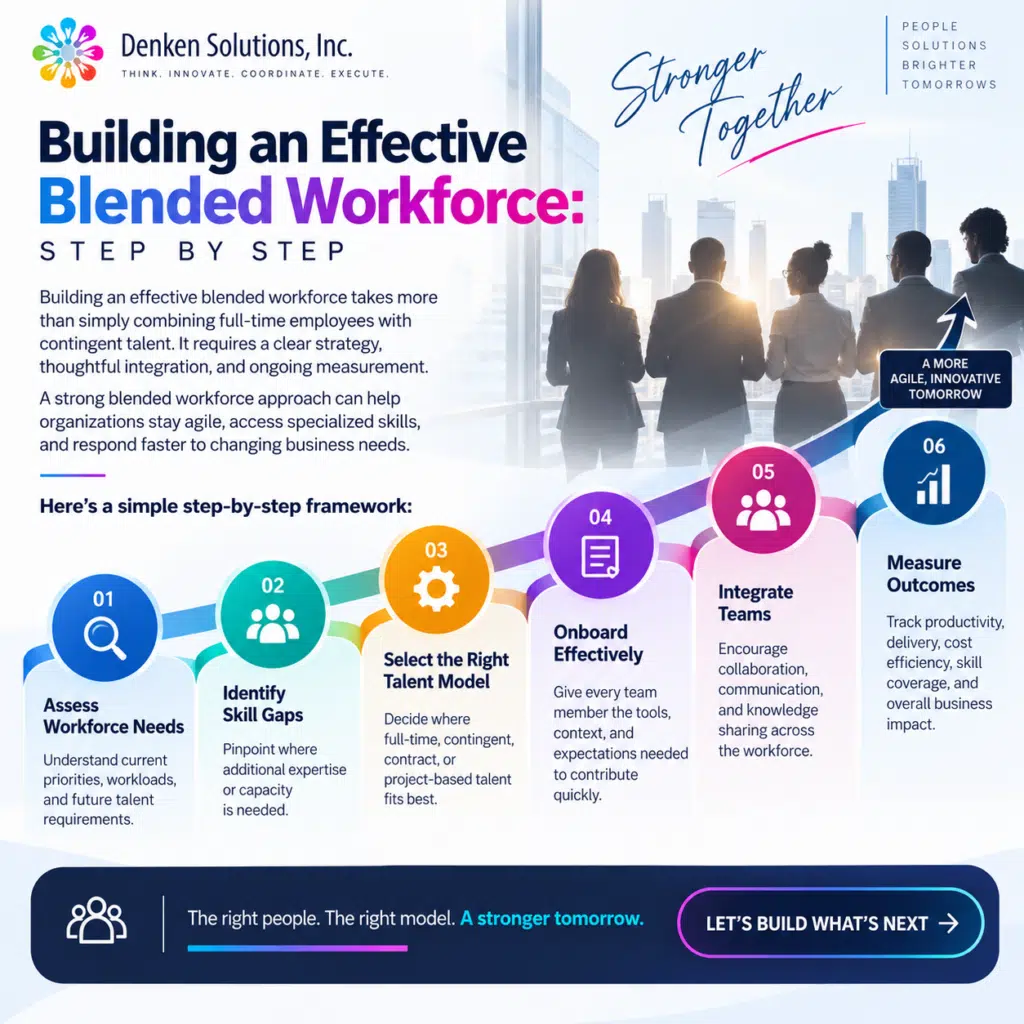
As businesses are building increasingly more flexible workforce models, contingent talent are increasingly working along side full-time employees. When managed properly, this blended approach can improve agility, bring in specialized talent, and help teams scale quickly. The challenge is to ensure that everyone can collaborate efficiently while also maintaining clear expectations, strong communication, and the right governance. Key considerations for successfully blending contingent workforce talent with a full-time team include:
1. Define responsibilities and roles clearly
Establish who will own what, how the decisions are made, and where contingent talent will fit within the broader team. Clear boundaries will reduce duplication, delays, and confusion.
2. Create a consistent onboarding experience
Contingent workers tend to quickly understand the company, goals of the project, workflows, tools, and key stakeholders. A well-structured onboarding process will help them in becoming productive quickly.
3. Build a strong communication process
Include contingent professionals in the updates, meetings, and project conversations which are relevant to the work. Consistent communication will keep everyone aligned and also prevent any gaps in information.
4. Encourage an inclusive team environment
Employment type should not become a hurdle to collaboration. Encourage mutual respect, knowledge sharing, and teamwork so that all contributions will feel connected to shared objectives.
5. Plan a process for knowledge transfer
Document all the important processes, project knowledge, and decisions throughout the engagement process. This will reduce any disruption when a contract will end or when responsibilites transition to another team member.
6. Manage access and security carefully
Provide contingent workers with the tools and system access they require while also maintaining appropriate controls around the sensitive information, confidential data, and internal systems.
Conclusion
The fusion of full-time workers with a contingent workforce, as discussed in this article, acts as a strategic tool for organizations seeking to transform their workforce strategy. It offers uncountable benefits to employers: flexibility, scalability, access to specialized skills, improvement in the talent acquisition process, diversity and innovation, and many more. If you intend to shift to a blended workforce model that seamlessly integrates your fixed employees with contingent workers, start leveraging contingent workforce strategies and staffing platforms like Denken Solutions. At Denken Solutions, we not only help you implement a blended workforce but also provide custom-made staffing solutions that fuel your business growth.
Ready to build a stronger workforce? Become our customer and let us handle your staffing needs