Hiring skilled talent for AI and cloud computing contract roles is increasingly becoming challenging for businesses. As organizations accelerate digital transformation, demand for IT staffing vendors is also growing. However, finding the right candidates with the required skills, hands-on experience, and project-specific expertise usually takes way longer than expected.
Unlike traditional IT roles, AI and cloud contract roles often require niche technical skills, immediate availability, and the ability to contribute from day one. These requirements can significantly extend the time to fill a candidate, delay any important projects, and also increase recruitment-related costs.
In this blog, we have explored the primary factors behind long hiring timelines, why niche IT roles take longer to fill, and practical strategies to streamline recruitment for AI and cloud engineer contract hiring and contract roles.
What is time-to-fill in IT contract staffing?
Time-to-fill is a recruitment metric that primarily measures the total number of days between when a job opening is approved or posted and when a candidate accepts the offer. In IT contract staffing, it significantly helps companies analyze how quickly they can secure qualified technical talent for short-term, long-term, or project-based assignments.
Time-to-fill differs from time-to-hire. Time-to-fill measures the complete duration of filling a vacancy, while time-to-hire tracks the time between a candidate entering the recruitment process and accepting an offer.
For AI ML contractor hiring, time-to-fill is especially important since businesses require professionals who can contribute to projects within the assigned deadlines. Delays in hiring AI engineers, cloud architects, DevOps specialists, or other technical contractors can significantly affect project timelines, increase workloads for existing teams, and also slow down important business operations.
Why do AI and Cloud contractor roles take longer to fill?
Hiring an AI and cloud engineer contract hiring for contract positions could get increasingly challenging than filling a traditional IT role. These positions usually need specialized technical skills, relevant project experience, and candidates who can begin working within a short span of time. Various factors contribute to long hiring cycles:
1. Limited availability of specialized technical skills
AI and cloud technologies require talent with experience in areas such as machine learning, DevOps, cloud architecture, cloud security, and generative AI. Hiring a candidate with the correct mix of technical knowledge and experience can get extremely difficult. This is especially for highly specialized projects.
2. Highly specific project-related requirements
Multiple cloud projects and AI require talent who are acquainted with certain platforms, tools, and frameworks. One of the primary examples is that a cloud engineer needs to have experience with AWS or Azure, Kubernetes, Terraform, and some security practices. The more specific the requirements are, the smaller the pool of suitable candidates can become.
3. Competition for experienced cloud talent and AI
Businesses across various industries are investing in adopting AI and cloud infrastructure. This results in competition for experienced talent. This is especially true for those with proven experience handling complicated implementations. Contract talent can also compete with permanent talent opportunities, which offer better job stability and long-term benefits.
4. Various technical screening and approval stages
Evaluating candidates for AI and cloud roles usually involves technical assessments, practical evaluations, and interviews with various stakeholders. While these steps will help ensure candidates meet project requirements, long approval processes and delayed feedback could increase the time-to-fill.
Understanding the time-to-fill bottlenecks: Where do the days go
Reducing the time-to-fill will need way more than just sourcing candidates as quickly as possible. US employers should also examine how much time every recruitment stage takes, from opening the requisition to securing an accepted offer. The table highlights the common bottlenecks and practical ways to address them.
| Hiring stage | Common bottlenecks | How to reduce delays |
| Requisition approval | Delays in confirming budgets, contract duration, and technical requirements | Align hiring managers, HR, and budget owners before opening the role |
| Candidate sourcing | Limited availability of professionals with specialized AI and cloud skills | Maintain updated talent pipelines and use targeted sourcing channels |
| Candidate screening | Time spent verifying technical expertise and project experience | Use consistent screening criteria focused on essential skills |
| Technical interviews | Multiple interview rounds, scheduling conflicts, and delayed feedback | Consolidate assessments and establish clear feedback deadlines |
| Offer and acceptance | Rate negotiations, unclear contract terms, and approval delays | Confirm rate ranges, project expectations, and approval responsibilities early |
6 ways to reduce time-to-fill for AI and cloud contract roles
Reducing the time to hire for AI and cloud contract roles actually needs a recruitment strategy. This helps in balancing speed and quality of candidates. By streamlining the hiring process, improving coordination between hires, and addressing the common challenges associated with recruitment, your company can easily hire secured talent efficiently.
1.Define the technical requirements properly
Hiring managers are supposed to identify important technical skills, experience, and qualifications. This should be done before starting the recruitment process. Separating the required skills from preferred qualifications will assist recruiters in focusing on suitable candidates. Prioritize experience with certain cloud platforms or AI frameworks instead of requiring expertise across various technologies. This helps in expanding the talent pool, reduces unnecessary screening, and accelerates candidate selection.
2. Building a pipeline of pre-screened candidates
Maintaining a pipeline of qualified AI engineer talent, cloud architects, and DevOps specialists will help companies respond quickly to new hiring requirements. Recruitment teams are required to regularly update candidate profiles, technical skills, and information regarding availability. Building relationships with talent interested in future contract opportunities can reduce sourcing time and make it easy to identify suitable candidates when new projects come.
3. Simplifies the process of technical interviews
Long interview processes involve various assessment rounds and delay feedback. This can push back recruitment timelines. Organizations should establish structured technical evaluations that focus on relevant skills and project requirements. Reducing unnecessary interview rounds, using standard assessment criteria, and providing regular feedback can accelerate hiring decisions while maintaining the quality of candidates.
4. Offers competitive contract rates and flexible terms
Attracting experienced AI and cloud engineer contract hiring will require competitive compensation and clearly defined terms of contract. Organizations should align contract roles with market-related expectations and communicate the duration of the project, responsibilities, and working arrangements upfront. Offering a remote or hybrid opportunity when possible can expand the talent pool. Transparency about contract expectations can reduce negotiation delays.
5. Improves coordination between recruiters and hiring managers
Efficient communication between hiring managers and recruitment teams is important for reducing any delays in hiring. Clearly defining job requirements, establishing interview schedules, and establishing feedback deadlines will help in maintaining recruitment momentum. Assigning responsibilities for candidate evaluations and approvals also reduces any unnecessary waiting periods and ensures hiring decisions are made efficiently.
6. Partner with specialized IT staffing providers
Through established talent networks, specialized IT staffing services can assist organizations in finding competent AI and cloud workers. By helping with candidate sourcing, preliminary screening, and interview coordination, these partners lighten the burden on internal recruitment teams. Their comprehension of contract market expectations, personnel availability, and technical skill needs can assist companies in streamlining hiring and more effectively filling specialized roles.
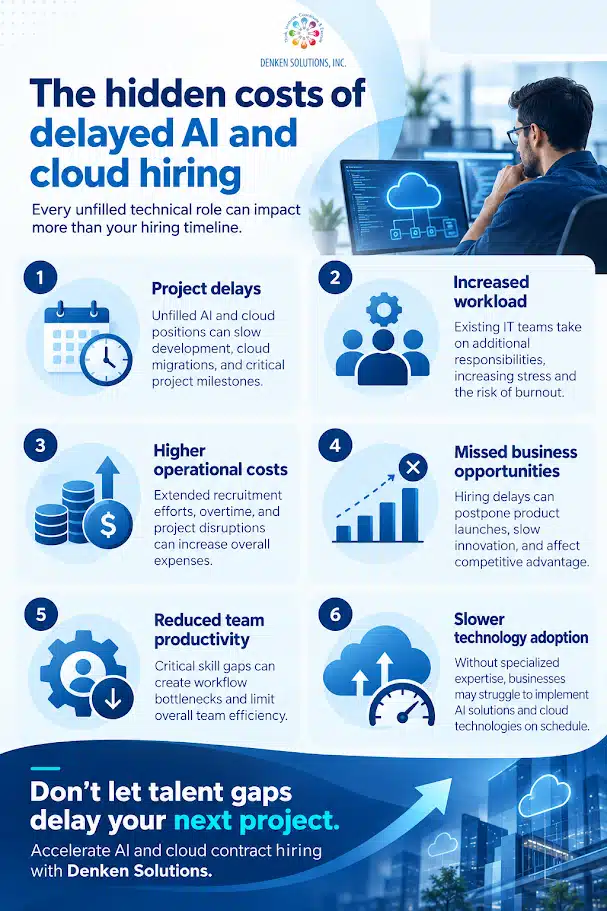
How contingent staffing supports faster AI and cloud hiring
Contingent staffing helps companies overcome certain challenges associated with hiring. They provide quicker access to experienced AI and cloud professionals. Instead of depending just on the traditional recruitment processes, businesses can use flexible staffing solutions to meet the project requirements, reduce delays in hiring, and also maintain operational efficiency. To reduce any delays in hiring and finding the right technical talent, you should evaluate IT staffing vendors depending on the expertise of industry, candidate screening processes, and ability to meet specialized AI and cloud hiring requirements.
1. Access to pre-screened talent
Contingent staffing providers maintain a huge network of qualified AI and cloud talent. This reduces time spent sourcing and evaluating candidates.
2. Quick recruitment process
Specialized staffing partners will streamline the process of candidate screening, shortlisting, and interview coordination. This helps organizations make hiring decisions increasingly efficiently.
3. Access to specialized technical skills
Businesses can find contractors with experience in machine learning, cloud architecture, generative AI, DevOps, and other in-demand technologies without conducting long talent searches.
4. Flexible workforce scalability
Organizations can easily expand or adjust their technical teams depending on the demands of projects, workloads, and changing business needs.
Accelerate AI and Cloud contract hiring with Denken Solutions
Finding qualified AI and cloud talent should not slow down important technology-related projects. Denken Solutions is a niche tech staffing partner that helps businesses address IT talent gaps with flexible contract staffing solutions tailored to your technical requirements and project timelines.
With experience in IT staffing and recruitment, Denken Solutions helps organizations identify skilled talent across artificial intelligence, machine learning, cloud computing, DevOps, and other emerging technologies. Our recruitment approach tends to focus on matching candidates with the right technical skills, experience in projects, and business needs.
Whether you are expanding an AI development team, handling a cloud migration, or seeking specialized expertise for a time-sensitive project, Denken Solutions will help in streamlining your hiring process and reduce recruitment bottlenecks.
Conclusion
AI and cloud contract talent usually take a long time to fill because of unique skill requirements, massive competition, and traditional hiring processes. Productivity, project schedules, and company expansion can all be impacted by these delays. Companies can reduce hiring delays and also obtain the technical requirements to maintain important AI and cloud projects on schedule by optimizing the process of recruitment, creating huge talent pipelines, and utilizing contingent staffing solutions.
Become our customer and let Denken Solutions help you find the right IT talent to meet your business needs.
FAQs:
1. Why do AI and cloud contract roles take longer to fill?
AI and cloud contract roles often require specialized technical skills, hands-on project experience, and industry-specific expertise. Limited talent availability, high competition, and complex screening processes can extend hiring timelines.
2.What factors affect time-to-fill in IT contract staffing?
Key factors include talent availability, technical skill requirements, compensation expectations, interview processes, and onboarding procedures. Inefficient recruitment workflows can further increase hiring delays.
3. How does contingent staffing help accelerate AI and cloud hiring?
Contingent staffing provides access to experienced technical professionals for specific projects. Staffing providers can simplify sourcing, screening, and onboarding, helping businesses fill critical skill gaps more efficiently.
4. How does Denken Solutions help companies hire AI and cloud contractors?
Denken Solutions provides specialized IT staffing solutions to help businesses find qualified AI and cloud professionals. Its recruitment approach focuses on matching technical expertise with project requirements to support efficient hiring.
5. What types of AI and cloud professionals can Denken Solutions help businesses hire?
Denken Solutions supports recruitment for specialized IT roles, including AI engineers, machine learning specialists, cloud engineers, cloud architects, and DevOps professionals, based on business and project requirements.