As the business environment is getting so dynamic, contingent workforce programs are becoming an important part of preparing workforce strategies, assisting companies in accessing specialized talent, improving flexibility, and adapting quickly to changing business demands. However, handling a contingent workforce efficiently will need way more than tracking the number of workers. It will need actionable insights into costs, performance, compliance, supplier effectiveness, and overall program efficiency. By working with a monthly contingent workforce metrics program, a contingent workforce metrics program manager can easily identify trends, make data-driven decisions, optimize resources, and highlight the impact of their programs across the company.
In this blog, we have explored six primary contingent workforce metrics that every program manager should track monthly to improve visibility, enhance decision-making, and drive better workforce outcomes.
What is contingent workforce reporting?
Contingent workforce reporting is the process of analyzing and collecting data regarding the company’s non-permanent workforce. This includes contractors, temporary workers, freelancers, consultants, and SOW resources. It will also help program managers and business leaders to gain visibility into costs, workforce size, utilization, performance, and compliance. Unlike traditional employee reporting processes, it focuses on the flexible talent organizations use to meet changing business requirements.
For program managers, contingent workforce reporting will support better decision-making by tracking key metrics like contractor spend, supplier performance, and compliance. It will help organizations improve workforce visibility, reduce risks, control costs, and optimize the use of contingent talent.
Why is contingent workforce reporting important?
Contingent workforce KPIs for reporting is important for businesses to gain increased visibility into their flexible workforce and also make data-driven decisions. It will also help program managers understand workforce trends, monitor costs, improve resource allocation, and ensure contingent workers are effectively working on their business objectives.
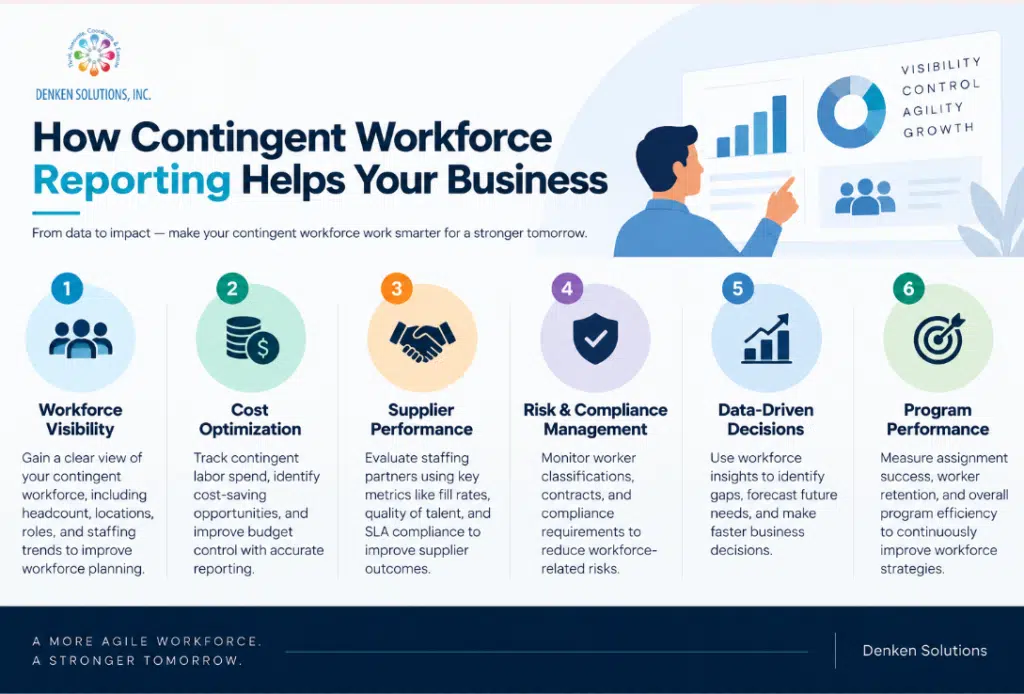
1. Improves your cost management
Contingent workforce reporting will help companies to gain control over contractor spending by tracking expenses across multiple departments, suppliers, and projects. It will allow program managers to identify spending patterns. Therefore, you can easily prevent budget overruns and uncover opportunities for cost optimization.
2. Improves workforce flexibility
Reporting will provide a clear view of the contingent workforce. This includes worker numbers, locations, roles, and project assignments. This visibility will help companies understand how resources are getting used. This ensures that the right talent is being allocated to the right projects.
3. Improves decision-making
Accurate workforce data will allow program managers to make informed decisions about any hiring needs, workforce planning, and resource allocation. By analyzing trends and performance data, organizations can easily build efficient workforce strategies.
4. Significantly reduces compliance-related risks
Contingent workforce reporting will help companies monitor important compliance areas like contracts, worker classifications, documentation, and policy requirements. Regular tracking will reduce risks and also ensure workforce programs remain aligned with regulations.
5. Optimizes supplier performance
Reporting will allow companies to analyze staffing suppliers depending on primary factors like candidate quality, response time, rates of fulfillment, and service-level agreements. These insights will help strengthen supplier relationships and improve the overall outcomes of the workforce.
6 metrics every program manager should track monthly
Tracking the correct contingent workforce KPIs will help program managers to understand workforce performance, control costs, and also make improved decisions. Monthly reporting will provide a valuable and detailed insight into how efficiently contingent talent is being managed. It will also highlight areas where improvements can be made. By monitoring the primary workforce indicators properly, organizations can easily optimize resource planning, improve operational efficiency, and maximize the value of the contingent workforce.
1. Metric 1: Amount spent on contingent workforce
Tracking the total contingent workforce spend will help program managers understand where and how the company is investing in its contingent talent. Monitoring expenses by department, supplier, project, and worker category will help in identifying spending trends. It will also help manage budgets and uncover opportunities for cost optimization.
2. Metric 2: Rate of worker utilization:
The workforce utilization rate will measure how efficiently contingent workers are being deployed across projects and business functions. By simply analyzing active assignments, billable hours, and resource availability, program managers can easily identify underutilized resources. This will also ensure that your workforce capacity is aligned with business needs.
3. Metric 3: Hiring cycle time and time-to-fill:
Time-to-fill will measure how quickly a company can source and onboard a contingent worker. Tracking these metrics will help the program managers identify any delays in the hiring process. They can also work on improving workforce agility and ensure projects tend to have the right talent available when required.
4. Metrics 4: Supplier performance:
Supplier performance metrics will help in evaluating the efficiency of staffing partners and workforce suppliers. Program managers can easily track CW program reporting metrics. It includes factors like quality of candidates, response time, fulfillment rates, and also compliance with service-level agreements. This will help in improving supplier relationships and workforce outcomes.
5. Metrics 5: Contractor productivity and performance:
Monitoring contract performance will help businesses understand and analyse the quality and effectiveness of contingent workers. Metrics like project completion, deliverable quality, stakeholder feedback, and levels of productivity levels will provide insights into whether the workforce resources are meeting expectations.
5. Metrics 6: Risk metrics and compliance:
Compliance tracking will help organizations handle any risks associated with contingent workforce programs. Monitoring worker classification, documentation, contract status, and policies will make sure that your compliance requirements are being met. It will also reduce any potential legal or operational issues.
Challenges of working with a contingent workforce
Handling a contingent workforce will offer flexibility and access to specialized talent. However, it will also come with certain unique challenges. Program managers should balance workforce visibility, cost control, compliance requirements, and performance management. This is to ensure that contingent workers deliver value while also supporting goals of the business.
1. Limited visibility into workforce
Organizations usually struggle to maintain a clear view of their contingent workforce because of fragmented data across departments, systems, and suppliers. Limited visibility can make it quite tough to track worker assignments, availability, costs, and overall workforce utilization.
2. Handling costs efficiently
Without proper reporting and monitoring, contingent workforce expenses tend to rise quickly. Organizations can end up facing challenges with tracking spending, managing budgets, and also identifying areas where costs can be optimized.
3. Risk management and compliance
Contingent workforce programs usually need careful management of worker classifications, regulations, documentation, and contracts. Failing to maintain compliance can result in financial, legal, and operational risks.
4. Handling workforce quality
Ensuring consistent performance across contingent workers can get quite challenging. This is especially true when handling multiple suppliers and talent sources. Organizations require effective performance tracking and supplier management processes to maintain quality standards.
5. Managing data and reporting challenges
Gathering accurate workforce data can get difficult when information is spread across multiple systems. Incomplete or outdated data can significantly reduce the accuracy of reporting and also make it difficult for program managers to make an informed decision.
Best practices for effective monthly workforce reporting
Effective monthly workforce reporting will help program managers transform workforce data into simple, actionable insights. By following a structured reporting process, organizations can easily improve their visibility, make informed choices, and also ensure that their contingent workforce strategy will remain aligned with the goals of your business. Consistent and accurate reporting will also help in identifying trends, managing risks, and optimizing workforce performance.
1. Define the reporting goals and metrics clearly
Establish the primary objectives of workforce reporting and identify the metrics that will matter most to your company. Tracking the relevant KPIs like workforce spend, supplier performance, utilization, and compliance will ensure that reports provide meaningful insights.
2. Maintain updated and accurate data
Reliable reporting tends to depend on accurate workforce data. Organizations should often update data related to costs, contracts, workers, assignments, and supplier details to ensure reports reflect the current workforce landscape.
3. Standardize the reporting process
Create a consistent reporting format and process. This will make it easy to compare data, identify any trends, and share insightful data with the stakeholders. Standardized reports will improve efficiency and ensure that all teams are working with the same data.
4. Focus on insights and trends
Monthly workforce reports tend to go beyond presenting numbers. Program managers should analyze trends, identify challenges, and highlight opportunities for improving support for strategic decision-making.
How Denken Solutions helps program managers track critical workforce metrics
Handling a contingent workforce will need accurate data, real-time visibility, and the ability to make informed decisions. For program managers, tracking workforce metrics manually across multiple systems can be extremely challenging and time-consuming. Denken Solutions is a staffing platform that will help your business streamline contingent workforce services by providing the insights required to monitor performance, handle costs, and optimize workforce operations.
1. Improves visibility into workforce spend
Denken Solutions will help program managers gain increased visibility into contingent workforce expenses by tracking spending patterns across suppliers, workers, projects, and business units. This will allow organizations to evaluate budgets and identify cost trends, and also make informed decisions to improve cost management.
2. Better workforce usage tracking
Understanding how efficiently contingent workers are being deployed is important for optimizing resource utilization. Denken Solutions will help the program managers analyze resource utilization, assignment details, and workforce demand to ensure the right talent is allocated to the right projects.
3. Helps in enhancing supplier performance management
Managing multiple workforce suppliers will require consistent performance monitoring. Denken Solutions will help program managers in evaluating supplier effectiveness through key indicators. This includes fulfillment rates, response times, quality of candidates, and service-level performance. This enables stronger supplier relationships.
Conclusion
Effective contingent workforce reporting enables organizations to gain better visibility, manage costs, and improve workforce performance. By tracking key monthly metrics such as workforce spend, utilization, time-to-fill, supplier performance, contractor productivity, and compliance, program managers can make data-driven decisions and optimize workforce strategies. As contingent workforces continue to expand, leveraging accurate reporting and workforce insights becomes essential for improving efficiency, reducing risks, and maximizing the value of flexible talent. Solutions like Denken Solutions help organizations streamline reporting, enhance workforce visibility, and empower program managers with the insights needed to build a more agile and effective contingent workforce program.
FAQs:
1.What is contingent workforce reporting?
Contingent workforce reporting is the process of collecting, analyzing, and tracking data related to non-permanent workers, including contractors, freelancers, temporary employees, and consultants. It helps organizations monitor workforce costs, performance, compliance, and utilization to make better workforce decisions.
2. Why is contingent workforce reporting important for program managers?
Contingent workforce reporting helps program managers gain visibility into workforce operations, control costs, improve resource allocation, and identify potential risks. By tracking key metrics regularly, program managers can make data-driven decisions and optimize their contingent workforce strategy.
3. What metrics should program managers track for a contingent workforce?
Program managers should track key metrics such as contingent workforce spend, workforce utilization rate, time-to-fill, supplier performance, contractor productivity, and compliance metrics. These indicators provide insights into workforce efficiency, cost management, and overall program performance.
4. How can Denken Solutions help organizations improve contingent workforce reporting?
Denken Solutions helps organizations simplify contingent workforce management by providing better visibility into workforce data, performance metrics, and operational insights. Its solutions enable program managers to track important KPIs, improve reporting accuracy, manage costs, and make data-driven workforce decisions.
5. How does Denken Solutions support program managers in tracking workforce metrics?
Denken Solutions helps program managers monitor critical metrics such as contingent workforce spend, utilization, supplier performance, compliance, and workforce trends. By providing actionable insights, Denken Solutions enables organizations to improve workforce planning and optimize contingent labor programs.