A contingent workforce is a talent pool of contract workers, freelancers, gig workers, and other independent workers who work for a defined duration based on the requirements of the hiring company. The benefits of contingent workforce adoption are well documented from cost savings to on-demand access to specialized skills.
The workflow often goes like this, the hiring company provides their job requisitions information over to contingent staffing agencies. staffing companies will then source suitable candidates and present them over to the hiring company who will then interview them and determine if they would like to bring them onboard for a defined duration, often working on a project. In the current challenging states of affairs where unanticipated employee shortages and a surplus of tasks are bringing out uncertainties regarding project implementation, many companies consider leveraging a contingent workforce a most fitting solution.
In this article, we explore the key advantages of contingent workers and why more businesses are making this shift
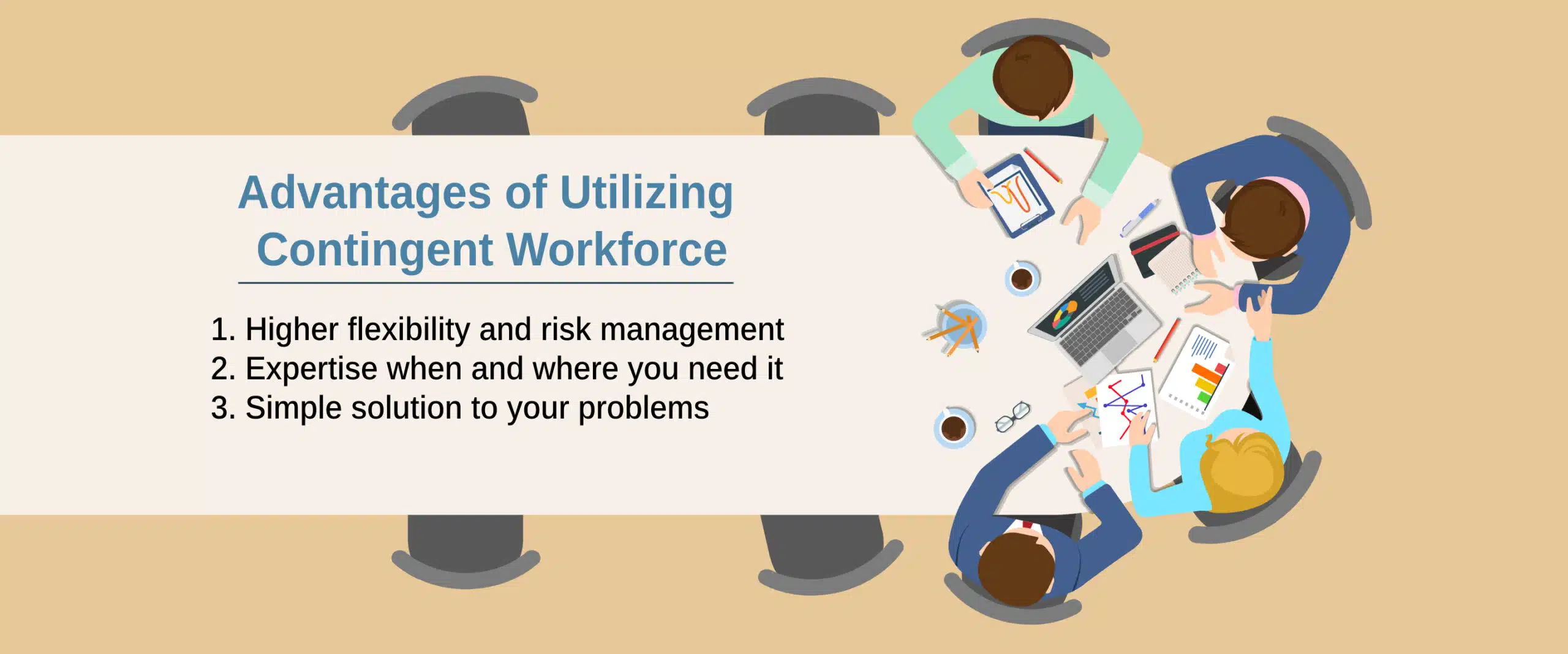
Advantages of contingent workforce
-
Scale your workforce up or down without long-term commitment
One of the top advantages of leveraging contingent employees is the flexibility to scale according to demand and the risk mitigation when down scaling. Based on the volatility in the market today where demand fluctuates drastically, companies can scale up to increase the workforce or scale down to decrease their workforce as needed by using contingent workers without damaging the company’s reputation as often happens in the case of full-time employees (think better.com).
-
Access specialized skills and niche expertise on demand
A contingent workforce typically has deep expertise in a very technical area which companies may have a hard time hiring especially if the company only needs the particular skill set for a limited duration. E.g. A company may need a cloud middleware engineer to integrate their e-commerce application with their ERP system for a one-time project but may not have enough subsequent responsibilities to keep the engineer active for a longer period. Their expertise in particular niches in various industries and related businesses can help companies to build special strategies for improved business processes.
-
Reduce hiring overhead and fixed employment costs
Hiring a contingent workforce is simpler for managers. You don’t have to think about the performance development plan, chart out a growth course and training plan for their careers, have a compelling total rewards program, etc. There’s also a limited amount of performance evaluation that you’ll have to provide. If the experience is bad, just let your staffing companies know and they’ll rectify the problem.
Also read: Why temporary administrative roles are critical for growing organizations
Final Thoughts
As stated, there are many advantages in utilizing a contingent workforce for companies. Companies’ HR teams should utilize this as a tool for their talent solutions. Whatever your organization’s requirements are in staffing, Denken Solutions is always prepared to assist with your talent solutions. We identify, analyze, and hire well-qualified individuals for companies by utilizing a broad database of talents. What do you have to do? Just become our partner, cite your requirements and challenges, and get it done!