Contract work can add high value to your resume by proving that you can adapt quickly, contribute across multiple projects in a certain way, and build skills in various work-related environments.
In July 2023, 4.3% of employed Americans, or approximately 6.9 million people, had contingent jobs as their primary employment, according to the U.S. Bureau of Labor Statistics.
However, various short-term assignments will sometimes result in making a resume look inconsistent if they are not presented properly. You must be wondering how to put contract work on resume. Well, The key is to label contract roles properly and also focus on the achievements, skills, and results you will deliver during every assignment.
Instead of hiding a temporary or contingent experience, utilize your resume to show how every contract will contribute to your professional growth. Highlight the measurable outcomes, relevant tools, and technologies, exposure to the industry, and contract-to-hire conversion when applicable. With the correct structure, contract work will demonstrate flexibility, specialized expertise, and the ability to deliver value quickly, thus helping recruiters and ATS systems understand the strength of your experience.
This guide will help explain how to highlight temporary work on a resume so that recruiters can easily understand the value of the experience.
Does contract work look good on a resume?
Contract work can be a great addition to your resume, especially when it is presented with the correct context. A contract position on a resume can make your career look unstable. However, a well-structured contract experience can help in showing recruiters that you can adapt, are comfortable entering new environments, and are capable of delivering value within short timelines. It can also help in demonstrating exposure to multiple industries, teams, technologies, clients, and types of projects. The key is to clearly label every role as contractual, explain what exactly you were responsible for, and also focus on the results you achieved rather than just the duration of the assignment.
1. Proves adaptability:
Contract talent is usually expected to understand the new teams, tools, processes, and expectations as quickly as possible. Highlighting this specific experience can show recruiters that you are flexible, resourceful, and able to become productive in unfamiliar environments.
2. Build specialized experience:
Multiple contract assignments will help in developing technical skills, industry knowledge, client-facing experience, and project experience. The variety can make your profile way more attractive, especially when the experience directly matches the role you plan to apply for.
3. Highlight results over tenure:
A short contract will still be valuable if you have delivered meaningful results. Focus on measurable achievements like completing projects, improving processes, reducing costs, increasing efficiency, or meeting any important deadlines.
4. Demonstrate a project-based experience:
Contract roles usually involve working with certain projects, implementations, launches, migrations, or business-related challenges. Showing what you have contributed to these projects in your contract employee resume can actually demonstrate that you know how to work towards clear objectives and also deliver within the assigned deadlines.
5. Proves exposure to multiple work environments:
Working with various organizations will give you experience with multiple company cultures, workflows, systems, and management styles. This will demonstrate broader professional exposure than someone who has worked in just a single environment.
Also read: How to use AI to optimize your resume for ATS systems
How to list contract work on your resume
Listing contract work will help your recruiters correctly understand that a short period of employment was a part of the planned assignment. Contract roles usually add strong value to your contract work resume. This is especially true when they show relevant skills, exposure to various industries, and the ability to produce results within a certain period of time. The important aspect is to make the employment structure clear while also focusing on what you have contributed in the assignment.
1. Clearly mention your contract work:
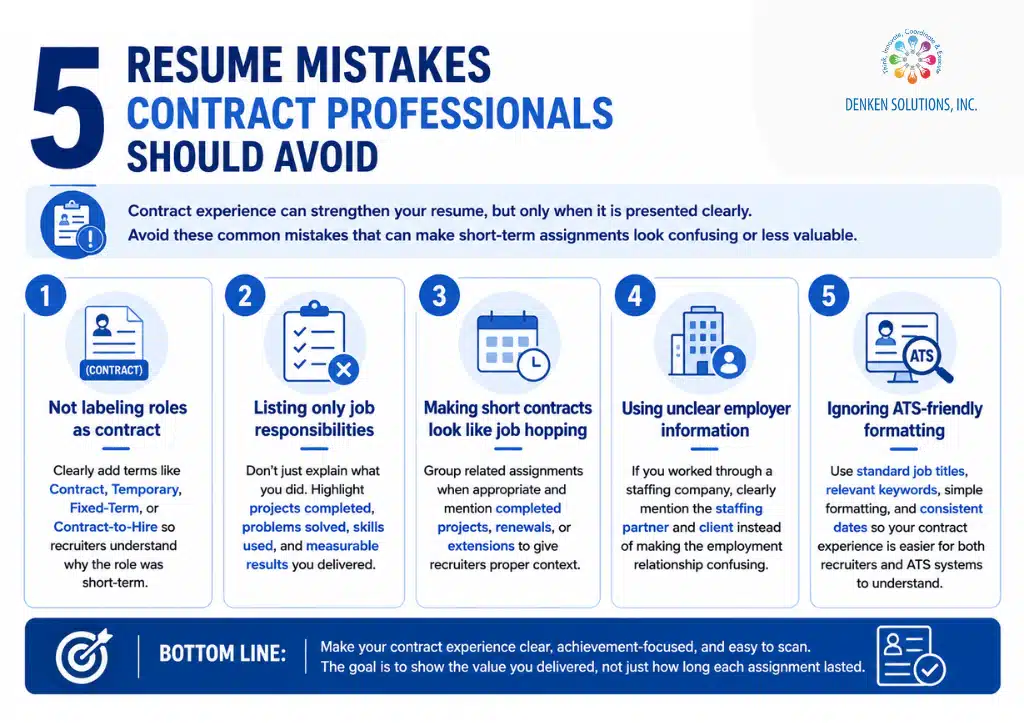
Always include terms like “contract”, “contract-to-hire”, “temporary”, or “fixed-hire” next to your job title. This will help the recruiters understand why the role might have lasted just for a few months and will also prevent any confusion.
2. Mention the staffing company and client appropriately:
If you had gotten hired through a staffing agency, you should mention the staffing partner and client clearly and appropriately. This will ensure that your employment history is accurate and will also help the recruiters to understand the structure of the assignment.
3. Group multiple projects when possible:
If you have worked on multiple contracts through the same staffing company, you can consider grouping them under a single employer. This will make your resume clean, reduce any repetition, and also make your career timeline easy to follow.
4. Include relevant technologies and skills:
Always mention the platforms, tools, software, industry knowledge, and methodologies you have used during every assignment. Prioritize the skills that would match the job you are currently applying for.
5. Mention contract extensions, conversions, or renewals:
If your contract has been extended, renewed, or converted into a full-time position, you can include that information. It will show that the employer was satisfied with your performance and wanted to continue working with you.
How to make contract work ATS-friendly
To make contract experience ATS-friendly, you should keep the format of the resume simple. Also, use job-specific keywords and make assignments easy to understand. The goal should be to help both the ATS and recruiter identify your role, achievements, and skills.
1. Extract and use keywords from the job description:
You should review the job posting and identify the recurring skills, tools, responsibilities, and qualifications. Add these keywords naturally in the resume where it genuinely matches the experience of the contract. For example, if the role will emphasize SQL, Power BI, data visualization, and reporting, you should include these terms in the experience and skills section when applicable.
2. Use standard and clear job titles:
You should avoid using overly creative or vague titles that an ATS might not recognize. You can use common titles like Data Analyst, Business Analyst, Software Developer, Project Manager, or anything of that sort. Then, proceed to add “contract” or “contract-to-hire” next to the title for clarity.
3. Clearly identify the type of employment:
You should label short-term positions as temporary, contract, fixed term, or contract-to-hire. This will give important context to the role and will help in preventing a short assignment from looking like an unexplained job change.
4. Include professional and technical skills:
Mention the tools, software, platforms, methods, processes, and industry skills that you actually use during every assignment. These can also include technologies, project management tools, CRM systems, analytics platforms, programming languages, or other skills.
5. Use simple resume formatting:
You should always use standard headings like Professional summary, skills, work experience, education, and certifications. Avoid complicated layouts, excessive graphics, icons, or decorative elements, as they can make important data difficult for some ATS systems to interpret.
How to show short-term contract jobs without looking like a job hopper
Short-term contract roles will not make your resume look unstable. You can do this by giving recruiters some context to understand that the positions were temporary, while also keeping the focus on your skills, achievements, and career progression.
1. Clearly label every role as a contract:
Add terms like contract, temporary, fixed-term, or project-based next to the job title. This will immediately explain why the roles have lasted just for a few months and will prevent recruiters from assuming you left unexpectedly.
2. Highlight the completed projects:
Mention when the assignment ended since the project or contract was completed. This will help recruiters see that the short duration was expected rather than the result of poor performance.
3. Highlight the completed projects:
Mention when the assignment ended since the project or contract was completed. This will help recruiters see that the short duration was expected rather than the result of poor performance.
4. Focus on your achievements over tenure:
Instead of drawing attention to how long you had stayed, you should show what you have accomplished. Include measurable outcomes like projects delivered, processes improved, revenue supported, time saved, or costs reduced.
Also read: AI in Recruitment: Trends, Benefits & Future of Hiring
How Denken Solutions helps professionals find contract opportunities
Finding the right contract role is not just about viewing an open position. Job seekers also require clarity about the assignment, expectations of the client, skills required, interview process, onboarding, and what would happen after the contract starts. Denken Solutions supports professionals throughout this process by connecting qualified candidates with relevant contingent opportunities and helping them understand every stage of the assignment.
1. Help in connecting candidates with relevant contract roles:
Denken Solutions works to match professionals with contingent and contract opportunities that align with their skills, industry background, experience, and career goals.
2. Provides assignment and clear role details:
Candidates will get better clarity around job responsibilities, required skills, duration of the contract, work location, shift expectations, and other important assignment-related data before moving forward.
3. Support the screening and interview process:
Denken Solutions will help in coordinating candidate screening, interviews, client submissions, and communication so that professionals can move through the hiring process more smoothly.
4. Helps candidates understand client expectations:
Before joining an assignment, professionals should receive data about the role, project requirements, work environment, and performance expectations. This helps them prepare more effectively.
5. Assists with onboarding requirements:
Once selected, candidates may receive support with documentation, onboarding steps, start-date coordination, and other requirements needed before beginning the assignment.
Conclusion:
Contract work can help in strengthening your resume when it is presented properly and focuses on the value you have delivered. You should know how to list contract work on resume. By labeling contract roles efficiently, highlighting relevant skills and measurable achievements, and keeping the experience ATS-friendly, you can show recruiters that short-term assignments reflect adaptability and expertise rather than instability. A well-structured resume can turn contract experience into a strong advantage and helps in standing out for future opportunities with employers and staffing partners.
FAQs:
1 . How can I make contract work stand out on my resume?
Focus on measurable results rather than only responsibilities. Highlight projects completed, problems solved, processes improved, technologies used, and other outcomes you contributed to.
2. Will Denken Solutions explain the contract details before I accept a role?
Candidates are provided with relevant assignment information such as responsibilities, required skills, work location, shift expectations, contract duration, and other role-specific details before moving forward.
3. Can a contract role through Denken Solutions lead to a permanent position?
Some opportunities may be structured as contract-to-hire, while other contracts may lead to extensions or longer-term opportunities depending on client needs and candidate performance.
4. How do I make contract experience ATS-friendly?
Use standard job titles, relevant keywords from the job description, clear employment dates, simple formatting, and specific skills or technologies used during each assignment.
5. Can contract work help with a career change?
Yes. Contract roles can provide hands-on experience in a new field, help you develop new skills, and give employers evidence that you can perform successfully in your new career path.