Picking between contract staffing vs outsourcing can have a huge and direct impact on the workforce costs, flexibility, and the overall efficiency of the business. Both models will help companies to access skilled professionals without depending completely on full-time hiring. However, they both work quite differently when it comes to controlling costs, long-term value, and management.
Contract or contingent staff will give your business increased control over temporary or project-based workers. Outsourcing will shift certain functions or processes to an external service provider.
So, which option is the most cost-efficient?
The answer entirely depends on the hiring requirements, duration of the project, internal resources, and how much control you would like to have. In this blog, we have compared contract staffing vs outsourcing to help in understanding the cost differences, key benefits, and which model can be a better fit for your business.
What is staffing and types of staffing
Staffing is the process of hiring, recruiting, and handling employees for a business. It also includes developing, training, and compensating employees to ensure high retention rates of employees and high business success. The types of staffing include:
1. Temporary to permanent staffing
Under this, employees are often hired temporarily. This will allow your business to evaluate performance before offering the employee a permanent position.
2. Short-term staffing
Companies will hire temporary employees depending on phases such as during seasonal work, for special projects, or certain tasks that do not really need a long-term or permanent employee.
3. Long-term staffing
Long-term or permanent staffing targets employees to hire them for extended periods. This ensures stability, continuity, and skill development in the business.
What is outsourcing?
Staffing outsourcing is basically when a business hires an external service provider to handle certain tasks. Therefore, the service provider handles the task instead of an in-house team. Businesses usually outsource areas or skills related to IT, customer support, payroll, accounting, and recruitment. The provider will handle the people, processes, and technology that are required to complete the task. Workforce outsourcing will reduce internal workload, provide access to certain expertise, and help businesses scale efficiently.
Also read: Contract staffing vs permanent hiring: cost, speed, and risk
Contract staffing vs outsourcing: Cost comparison
When comparing contract staffing vs outsourcing, businesses should analyze beyond the basic hourly rate and service fee. The total cost can usually also include management, technology, recruitment, compliance, and operational support.
1. Staffing fees
Contract staffing usually involves paying for individual workers along with the staffing agency fees, payroll processing, benefits, onboarding, and compliance support. The cost will vary depending on the skill level of the worker and duration of the contract.
2. Service provider cost
Workforce outsourcing usually involves paying a vendor to handle tasks, processes, or an entire department. Pricing can again depend on the monthly fee structure, cost of the project, or service level agreement and scope of work.
3. Management costs
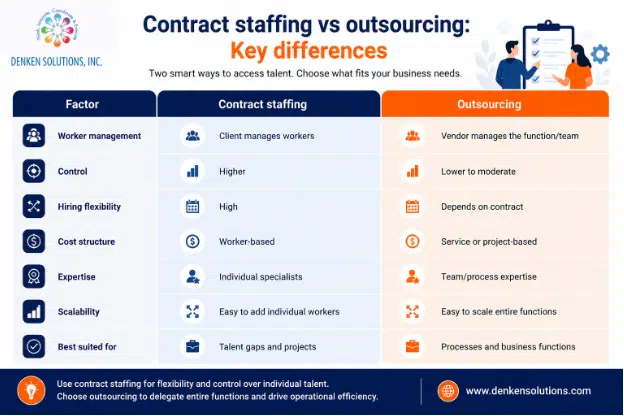
Contract workers are usually managed directly by your business. This helps in detailed inspection and understanding of the talent’s scope of work. With outsourcing, the service provider often handles day-to-day supervision, which can result in a lack of transparency for internal managers.
Contract staffing vs outsourcing: Which costs less?
Picking between contract staffing and outsourcing is not just about comparing prices. The actual cost will depend on various factors like the type of work, duration of the project, level of expertise required, internal management efforts, and whether the business requires individual professionals or the entire function to be handled externally.
There is not a single option that can be considered cheaper. The right pick will depend on the requirements of the company’s workforce, available resources, and long-term goals.
Contract staffing can cost less if the business requires certain professionals for a short-term project, seasonal demand, or a temporary skill gap. Companies can easily add talent without any long-term costs associated with permanent hiring.
Outsourcing can cost less when an entire function requires ongoing support. Since the outsourcing provider will usually handle staffing, technology, supervision, and processes, businesses can easily reduce internal management and infrastructure costs.
For short-term or specialized talent requirements, contract staffing usually provides increased cost flexibility. For ongoing processes which need dedicated management, outsourcing can deliver greater long-term savings. The most affordable choice will depend on the total cost of ownership, not just the hourly rate or vendor fee.
How to choose between contract staffing and outsourcing
Choosing between outsourcing vs contract staffing will depend on the requirements of the workforce, duration of the project, budget, internal resources, and the level of control you want over everyday work. Before deciding, businesses should evaluate the immediate cost and also the long-term operational impact of each model.
1. Consider the work
Contract staffing is often a better option when you need individual professionals with certain skills to support an existing team. Outsourcing can be more suitable when you need an external provider to take responsibility for an entire process, department, or business function.
2.Understand the duration of the requirement
Contract staffing will work well for a short-term project, seasonal demand, temporary workforce gaps, or specialized assignments. Outsourcing is usually well suited for ongoing, repetitive, or process-driven work that needs constant support.
3. Assess the capacity of the management
With contract staffing, the internal team usually handles the workers and oversees their responsibilities. This will give you increased control but will also need your management’s time. In outsourcing, the provider usually manages the team, workflows, and performance. This can reduce the burden on internal managers.
4. Compare the overall cost
Do not make a decision just on hourly rates or service fees. You should also consider recruitment, onboarding, payroll, compliance, training, technology, infrastructure, supervision, and vendor management costs. Looking at the total cost of ownership can also provide a more accurate comparison.
5. Analyse flexibility and scalability
Contract staffing can make it easy to increase or reduce headcount depending on the changing project requirements. Outsourcing can be increasingly effective when you need to scale an entire function without building additional internal infrastructure.
6. Consider the level of control needed
If maintaining direct control over how work is completed is important, contract staffing can be a better fit. If your priority is reducing internal workload and focusing on core business activities, outsourcing might offer greater value.
How Denken Solutions helps businesses reduce workforce costs with contract staffing
Denken Solutions will help your business access skilled professionals without any long-term costs and commitments associated with permanent hiring. Through contract staffing service, companies can easily bring in talent depending on project requirements, workload changes, or temporary skill gaps.
By using a flexible staffing model, businesses can reduce expenses related to full-time recruitment, long on-boarding cycles, and unnecessary headaches during slow periods.
Denken Solutions will support this process by assisting companies in finding qualified contract professionals efficiently and quickly. This will enable internal teams to focus on business priorities while also gaining access to the right talent when required.
Contract staffing with Denken Solutions can help businesses:
- Reduce long-term hiring costs: Companies can hire professionals for certain projects or defined projects instead of adding permanent employees for temporary needs.
- Scale teams depending on the demand: Businesses can increase or decrease their workforce as project requirements change. This helps in controlling labor costs more efficiently.
- Access specialised skills: Contract staffing will provide access to experienced professionals without needing a long-term employment commitment.
- Improves hiring efficiency: Denken Solutions will help in streamlining sourcing and staffing so businesses can fill workforce gaps quickly and reduce the cost of prolonged vacancies.
Conclusion
When comparing contract staffing vs outsourcing, the more cost-effective option will depend on your business requirements, project duration, management capacity, and desired level of control. Contract staffing is usually a strong choice for companies that require skilled professionals for specific projects or changing workforce demands while also avoiding long-term hiring commitments. Outsourcing can be better suited for businesses that need an external provider to handle an entire function or process.
FAQs:
1.What is the main difference between contract staffing and outsourcing?
Contract staffing provides individual professionals who typically work under the client’s management, while outsourcing transfers responsibility for a specific process or function to an external service provider.
2.When should a business choose contract staffing?
Contract staffing is a good option when a company needs flexibility, specialized skills, faster workforce scaling, or temporary support without making long-term hiring commitments.
3.What costs should businesses compare before choosing between the two?
Businesses should consider recruitment, onboarding, payroll, compliance, management time, technology, infrastructure, service fees, and other operational expenses rather than comparing only hourly rates.
4.How can Denken Solutions help with contract staffing?
Denken Solutions helps businesses connect with qualified contract professionals based on their project needs, skill requirements, and workforce goals. This can help companies fill talent gaps faster while maintaining flexibility and control over their teams.
5.Can Denken Solutions help reduce workforce costs?
Denken Solutions can help businesses control workforce costs by providing access to contract professionals without requiring long-term hiring commitments for temporary or project-based needs.