As financial services companies are expanding into new markets, adopting upcoming technologies, and responding to the changing customer demands, access to skilled talent is also becoming increasingly crucial. Traditional hiring models might not always offer the speed and flexibility required to support the growth of your business. Financial services workforce expansion is extremely crucial to keep up with the incoming requirements.
A well-planned approach to contract and temporary talent allows financial institutions to scale teams efficiently, access specialized experience, handle workforce costs, and respond to changing workloads. From regulatory compliance and risk management to IT, data analytics, and customer operations, contingent talent will help companies meet evolving business needs.
In this blog, you’ll learn how to build a scalable, compliant flexible staffing model to support financial services workforce expansion.
Why financial services expansion needs a flexible workforce strategy
Finance companies are entering new markets, introducing services, and scaling operations. This is making workforce requirements increasingly complicated. Traditional hiring models may not provide the speed, flexibility, or specialized experience needed to support these changes.
A flexible workforce strategy helps financial service companies respond to the evolving business demands while also maintaining operational efficiency and handling workforce costs.
Several factors can make workforce flexibility important during financial services workforce expansion:
1. Growing demand for specialized skills
Expansion usually requires talent with expertise in risk management, regulatory compliance, financial analysis, cybersecurity, and digital transformation. Contingent staffing enables access to these skills without needing permanent hires for each role.
2. Fluctuating workloads
Financial institutions experience changing staffing demands because of seasonal activities, regulatory deadlines, volumes of insurance claims, and market conditions. A flexible workforce enables organizations to adjust staffing levels depending on operational requirements.
3. Handling costs
Maintaining a large permanent workforce can increase fixed employment costs. A balanced approach combining permanent employees and contingent talent will help in aligning staffing expenses with actual business requirements.
4. Expanding geographically
Entering new markets can require additional workforce capacity, local expertise, and knowledge of regional regulations. Contingent professionals supports these requirements while organizations establish long-term operations.
5. Helps in operational continuity
Business expansion should not affect existing services. Contingent workers can provide extra capacity for important functions. This allows internal teams to maintain service quality while also supporting the growing initiatives.
Understanding the role of contingent workers in financial services
Contingent workers play a crucial role in helping financial institutions handle the changing workforce demands without expanding the permanent teams for every business-related requirement. These professionals are usually engaged for certain projects or temporary operational requirements. Effective new market financial workforce planning helps financial institutions identify talent gaps, allocate staffing resources, and build flexible teams to support business expansion. This provides organizations with access to specialized skills and additional workforce capacity.
Common contingent workforce models
Financial services organizations can help in adopting multiple contingent staffing models depending on operational needs:
- Temporary staffing: Professionals hired for short-term assignments, employee absences, or seasonal workload increases.
- Contract talent: Skilled individuals engaged for a defined period to support specialized functions like regulatory compliance, IT operations, or financial analysis.
- Project-based specialists: Experts who are brought in to complete certain initiatives, including digital transformations, implementations, and risk assessments.
Financial services functions that benefit from contingent staffing
Contingent professionals can support key functions across insurance, banking, investment management, and other financial services sectors.
- Risk management and compliance: Supporting regulatory reporting, internal audits, risk assessments, and compliance documentation.
- Financial accounting and reporting: Helping with financial statements, reconciliations, budgeting, and reporting during peak periods.
- Customer support and banking operations: Handling transaction processing, administrative tasks, customer inquiries, and back-office operations.
- Insurance claims processing: Providing additional capacity for claims administration, documentation reviews, and policy servicing during periods of increased demand.
- Cybersecurity, data analytics, and technology: Supporting software development, cybersecurity initiatives, system migrations, data management, and digital transformation projects.
By strategically integrating contingent talent into the above roles, financial institutions will be able to address sudden talent requirements, maintain operational continuity, and scale the workforce in accordance with business expansion goals.
| Functional area | Role of contingent workers | Business value |
| Risk management | Support risk assessments, financial analysis, and risk reporting. | Strengthens risk oversight during critical projects. |
| Regulatory compliance | Assist with KYC, AML reviews, compliance documentation, and regulatory reporting. | Helps manage compliance workloads and changing requirements. |
| IT & cybersecurity | Provide expertise in cloud migration, cybersecurity, system upgrades, and infrastructure support. | Accelerates technology initiatives and addresses skill gaps. |
| Data analytics | Support financial modeling, data analysis, business intelligence, and reporting. | Improves access to specialized analytical capabilities. |
| Finance & accounting | Assist with reconciliations, audits, financial reporting, and month-end processes. | Supports accuracy and efficiency during peak workloads. |
| Banking operations | Handle loan processing, transaction support, documentation, and operational backlogs. | Improves operational flexibility and turnaround times. |
How to build a contingent workforce strategy for financial services expansion
Implementing a new market financial workforce planning needs your company to align staffing decisions with operational demands, objectives of business, and regulatory requirements. A structured approach assists companies in accessing specialized talent, managing workforce costs, and maintaining efficiency as businesses tend to expand.
1. Map talent gaps by function: risk, compliance, finance and operations
Financial institutions should evaluate the existing employee skills, operational capacity, and workloads prior to expanding the workforce. Identifying gaps in talent helps in determining which roles need permanent employees and which can be supported by contingent talent.
2. Tie contingent hiring to the expansion plan: new market, product or acquisition
Contingent hiring helps in supporting certain expansion objectives. It can be entering new markets, launching financial products, or increasing operational capacities. Organizations should consider the following:
- Expected business growth and workforce demand
- Skills needed for any upcoming projects
- Hiring timelines and staffing budgets
- Long-term and short-term workforce requirements
Aligning staffing decisions with business-related priorities will ensure that the right talent is available when required.
3. Match the engagement model to the role’s risk and duration
Financial institutions should pick staffing models depending on duration of assignment, required expertise, and operational requirements. Temporary staffing supports seasonal banking activities or increased insurance claims volumes, while contract talent can help with compliance, cybersecurity, and financial technology projects.
4. Set compliance, screening and system-access guardrails
Compliance is important when handling contingent workers in highly regulated financial environments. Organizations should establish clear policies for worker classification, data security, and regulatory responsibilities. The key considerations include the following:
- Worker classification and employment compliance
- Background verification and screening
- Data protection and confidentiality
- System access and cybersecurity training
- Vendor compliance and accountability
Clear governance processes can help reduce risks and maintain operational accountability.
5. Choose a partner with financial services experience
Financial institutions should work with staffing providers who understand industry requirements and can deliver qualified talent. Evaluate potential partners depending on the financial services experience, recruitment capabilities, candidate screening processes, transparency with pricing, and ability to scale. The right staffing partner can help companies address shortages in talent and meet changing workforce requirements.
6. Onboard contractors into regulated workflows
Efficient onboarding helps contingent talent become productive while also maintaining operational standards. Organizations should also define responsibilities clearly, reporting structures, communication channels, and performance-related expectations. Providing the necessary training and appropriate system access also encourages smoother integration. A consistent onboarding process improves collaboration and reduces disruptions during business expansion.
7. Track results with financial services KPIs
Financial institutions should regularly evaluate contingent workforce performance to ensure that staffing decisions continue to support business objectives.
Important performance indicators include:
- Time-to-fill: Speed of filling contingent positions.
- Workforce utilization: Efficiency of resource allocation.
- Staffing costs: Expenses compared with allocated budgets.
- Assignment completion: Achievement of project objectives.
- Compliance performance: Adherence to regulatory requirements.
- Vendor performance: Quality and responsiveness of staffing providers.
Tracking these metrics helps organizations optimize staffing levels, control costs, and improve workforce planning.
Common challenges in contingent workforce management
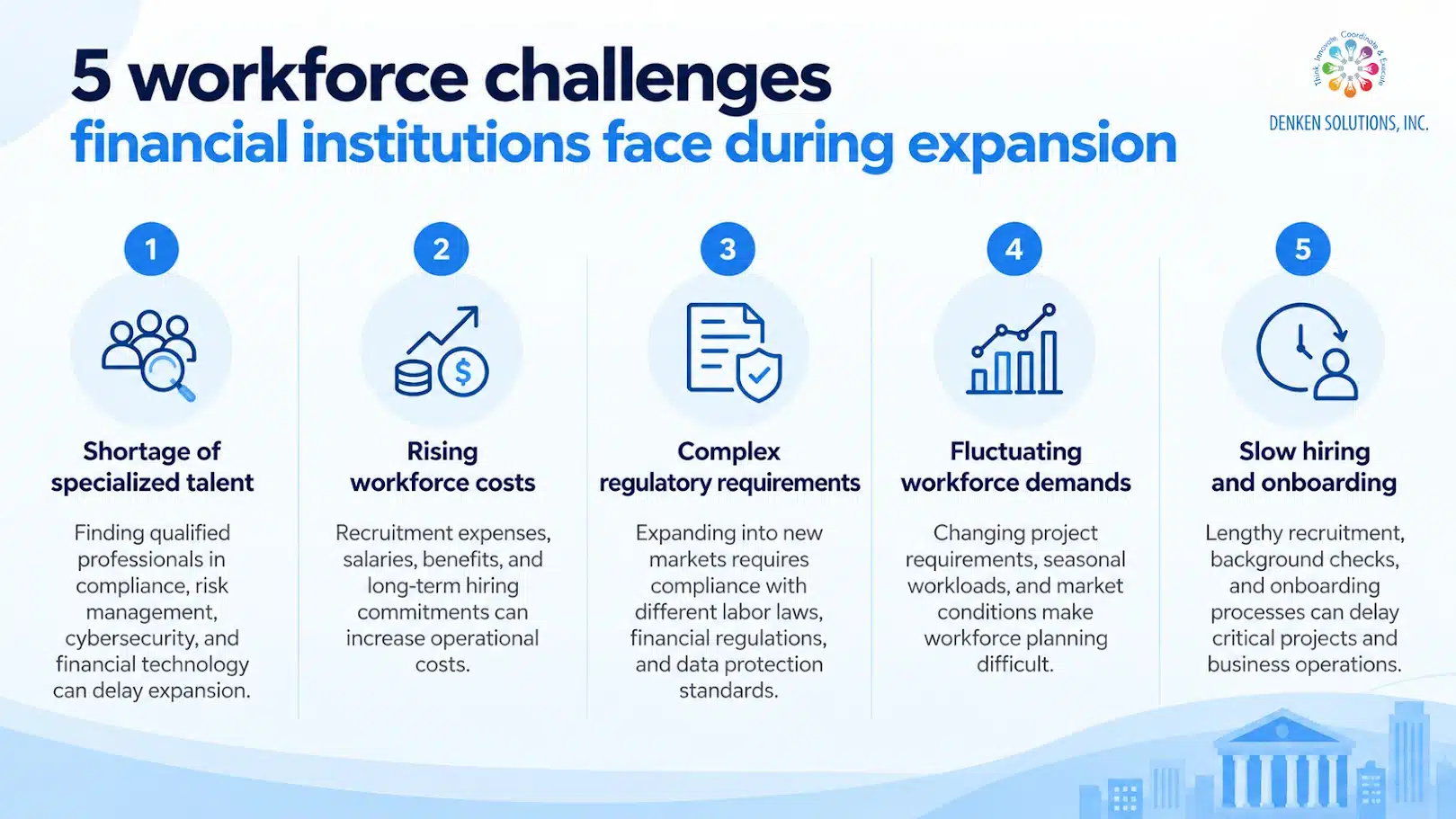
Although contingent staffing will offer flexibility and access to specialized talent, handling a contingent workforce can present various challenges for financial institutions. Without any proper planning and oversight, organizations can face difficulties related to workforce visibility, costs, compliance, and operational efficiency.
1. Limited visibility into workforce spending
Handling contingent workers across various departments and locations can make it quite difficult to track staffing expenses. Without any centralized reporting, companies can struggle to monitor budgets and identify unnecessary expenses.
2. Difficult to find specialized talent
Financial institutions usually need professionals with expertise in regulatory compliance, risk management, cybersecurity, and financial technology. Finding qualified candidates within tight timelines can get challenging.
3. Worker classification risks
Contingent workforce arrangements can result in risks related to employment regulations, confidentiality, worker classification, and financial data security.
How Denken Solutions helps financial institutions scale their teams
Scaling financial services operations requires access to skilled professionals, flexible staffing models, and efficient workforce management. Denken Solutions supports financial institutions with staffing solutions designed to address talent shortages, changing business demands, and expansion requirements.
-
Access to specialized talent
Denken Solutions helps financial institutions connect with qualified professionals across IT, financial operations, data analytics, cybersecurity, and other critical functions. This enables organizations to address skill gaps and secure the expertise needed for specialized projects and ongoing operations.
-
Flexible staffing solutions
Financial institutions can adjust their workforce based on project timelines, seasonal demands, and business growth. Through contract and contingent staffing arrangements, Denken Solutions helps organizations expand team capacity without committing to permanent hiring for every position.
-
Streamlined talent acquisition
Finding qualified professionals can be time-consuming, particularly for specialized financial services roles. Denken Solutions supports recruitment, candidate sourcing, and screening processes, helping organizations identify suitable talent and reduce delays in filling critical positions.
Conclusion
Building a strong finance contract staffing service is important for companies that are looking to expand while maintaining operational efficiency and controlling costs. As workforce demands are evolving, contingent staffing provides the flexibility to access specialized talent, handle fluctuating workloads, and support important business functions without any long-term hiring commitments.
However, a successful implementation requires careful workforce planning, efficient management of talent, following regulatory compliance, and smooth integration with the existing teams. By working with an experienced staffing provider like Denken Solutions, financial institutions can easily access qualified professionals, address any gaps in skills, and build an increasingly agile workforce that can support sustainable growth of your organization.
Ready to work with us Become our customer today Discover how our solutions can support your business goals and drive long-term growth.
FAQs:
1. Can contractors work on regulated financial tasks?
Yes, contingent workers can support certain regulated financial activities, provided they meet applicable regulatory requirements and company compliance policies. Organizations should establish appropriate supervision, access controls, confidentiality agreements, and role-specific qualifications before assigning sensitive financial responsibilities.
2. Which financial services roles are best filled with contingent talent during expansion?
Financial institutions can use contingent talent for roles such as financial analysts, risk and compliance support specialists, AML/KYC analysts, IT professionals, cybersecurity specialists, data analysts, and project managers. These positions can help businesses manage increased workloads and access specialized expertise during expansion.
3. How do you screen contingent workers who access financial data?
Screening should include identity verification, employment history checks, relevant background checks, professional credential verification, and assessments of technical skills. Organizations should also require confidentiality agreements, provide data security training, and implement role-based access controls to protect sensitive financial information.
4. How much of an expansion team should be contingent?
There is no fixed percentage of contingent workers that suits every financial services organization. The right mix depends on expansion goals, workload fluctuations, regulatory requirements, and available internal expertise. Businesses can retain permanent employees for core functions while using contingent professionals for temporary projects, specialized skills, and changing staffing demands.
5. How do you move contractors to permanent hires during expansion?
Organizations can transition contractors into permanent positions by evaluating their performance, skills, and long-term business fit. Before conversion, review staffing agreements, conversion fees, employment eligibility, compensation, benefits, and applicable labor laws. A structured onboarding process can help ensure a smooth transition into permanent employment.