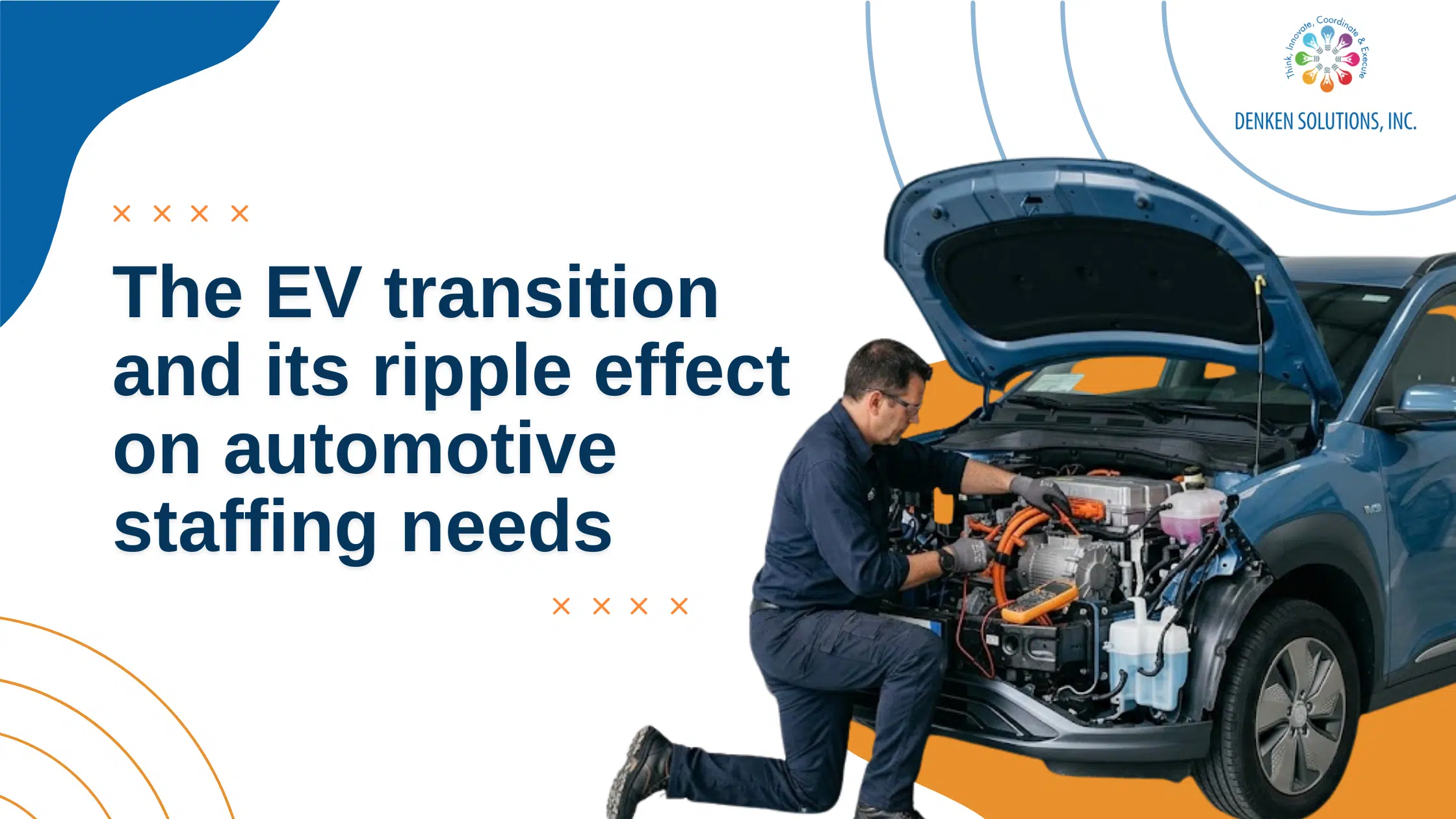
The global shift towards electric vehicles (EVs) is reshaping the entire automotive landscape. It is significantly transforming jobs not just in the automotive industry but also in servicing, logistics, and fueling. This transformation can have a major impact on millions of workers. Unlike the original equipment manufacturers, micro, small, and medium enterprises might not have the resources to invest in the latest technologies, retrain their workforce, and adapt quickly. For automotive companies, understanding these changes is important not just for maintaining production efficiency, but also for building a workforce that can innovate and scale in the EV era.
Contingent staffing service will provide automotive companies with the flexibility to fill specialized roles that are created by the EV transition. By hiring contingent or temporary talent, businesses can easily access niche skills, scale teams for short-term projects, and maintain operational efficiency without any long-term payroll commitments.
In this blog, we will explore how the EV transition is reshaping automotive staffing for electric vehicles, highlighting strategies your company can adopt to adapt to the changing landscape.
How the EV transition is reshaping automotive manufacturing
The transition to electric vehicles (EVs) is fundamentally changing how cars are engineered, designed, and manufactured. Unlike traditional internal combustion engine (ICE) vehicles, EVs require completely different components, materials, and assembly processes. The United Auto Workers (UAW) has promised $40 million to organize the non-union auto and EV battery workers. This highlights the expectations that the expanding EV battery industry will create multiple jobs across the USA in the coming years.
This can directly impact the manufacturing workflows and staffing requirements.
1.Changes in specialized materials and components
The shift to EVs can introduce new important materials like lithium-ion batteries, advanced composites, and rare-earth magnets. Production staff should be especially trained to handle these materials efficiently and safely. This ensures that quality and safety standards are being met.
2.Change in production lines and vehicle design
EVs have fewer moving parts than ICE vehicles. However, they highly rely on sophisticated battery systems, power electronics, and electronic motors. Manufacturing plants should adapt to handle these new components. This will require retooling of assembly lines, installation of battery assembly stations, and integration of high-voltage testing processes.
3.Decline in traditional ICE roles
As the EV adoption grows, the demand for engineers and technicians focuses primarily on ICE engines, transmissions, and exhaust systems is declining. Companies have to reskill or redeploy these workers into EV workforce roles or advanced manufacturing operations.
4.Increase focus on software and automation
EV manufacturing needs greater integration of robotics, automated testing, and digital monitoring systems. Employees should be comfortable with smart manufacturing technologies, IoT sensors, and data-driven quality control processes.
Emerging roles and skills in the EV industry
Since the shift towards electric vehicles, there has been an increase in entirely new staffing needs across the automotive industry. As the focus shifts from traditional internal combustion to advanced battery and electric systems, companies will need specialised skills and new roles to support innovation, production, and maintenance.
1.Management engineers and battery design
Experts in specialized battery chemistry, thermal management, and energy storage are important for developing efficient and long-lasting EV batteries. These engineers will handle the design, testing, and optimization of battery systems for various EV models.
2.Powertrain specialists and electric motor
EVs tend to depend on high-performance electric motors and advanced powertrains. Specialists in these areas will ensure there is optimal design, integration, and maintenance of electric propulsion systems.
3.AI/ML and software engineers
Modern EVs depend heavily on software for battery management, predictive maintenance, autonomous driving, and energy optimization. AI/ML engineers are important for developing intelligent systems that will improve vehicle performance and user experience.
4.Charging infrastructure and energy management professionals
With the growing demand for EVs, technicians and engineers who can design, deploy, and maintain charging stations and energy distribution systems are increasingly important. These roles will also cover grid integration and renewable energy compatibility.
How will contingent staffing support automotive hiring needs?
As the automotive industry is accelerating towards electric vehicles (EVs) and advanced manufacturing, your company can face an increase in the need for specialized skills and flexible workforce solutions. Hiring contingent staff on a temporary or project-specific basis will help the automotive business meet the changing demands. It will enable your company to access top talent quickly, scale teams according to project demands, and handle costs efficiently. All of this will ensure high-quality outcomes for critical projects.
1.Quick deployment of talent
Contingent staffing will allow you to quickly hire engineers, technicians, and specialists for a time-sensitive EV workforce. This includes battery plant establishments, software integration, and powertrain upgrades. This quick onboarding will reduce delays in production timelines and also ensure important milestones are met without overloading your permanent teams.
2.Access to specialized skills
Various EV-related projects need niche expertise that might not exist in your company. Contingent hiring will allow companies to tap into specialized talent pools for battery technology, electric motor design, autonomous vehicle software, and charging infrastructure, thus ensuring that projects have the right skills for success.
3.Flexibility and scalability
Contingent staffing will provide the flexibility to scale the workforce up or down depending on the requirements of the project. Companies can expand teams during peak production or innovation phases and reduce them once the work is complete, thus avoiding long-term commitments and maintaining operational agility.
4.Affordable hiring
Hiring for certain projects will help in managing benefits, payroll, and overhead costs efficiently. You will be required to pay for expertise only when required. This reduces any financial risks associated with permanent hires while also ensuring that projects are completed with high-quality standards and professional expertise.
5.Quickly reduce skill gaps
As the automotive sector is transitioning to EVs, there is usually a shortage of experienced personnel in emerging areas such as battery management or EV software. Contingent staffing will bridge these gaps. This enables companies to continue operations smoothly while also investing in reskilling or hiring permanent talent for the long term.
Contingent vs permanent staffing for EV projects
| Feature/aspect | Contingent staffing | Permanent staffing |
| Hiring Duration | Temporary, project-based (short-term) | Long-term employment |
| Flexibility | Highly flexible; can scale up or down quickly | Less flexible; requires full-time commitment |
| Cost | Cost-effective; pay only for project duration | Higher long-term payroll and benefits costs |
| Specialized Skills | Ideal for niche, high-demand roles | May lack specialized EV skills unless recruited carefully |
| Onboarding Time | Fast onboarding for immediate project needs | Longer onboarding process |
| Risk & Compliance | Easier to adjust headcount; needs EOR/contract support | Standard HR compliance; full benefits & contracts |
| Workforce Planning | Enables temporary scaling without long-term commitments | Fixed headcount; less responsive to project demand fluctuations |
| Project Focus | Best for time-sensitive or short-term EV projects (battery plant setup, software integration, powertrain upgrades) | Suitable for ongoing operations and long-term EV development |
Streamlining automotive contingent hiring with Denken Solutions
The automotive industry is constantly evolving with the rise of electric vehicles (EVs), smart manufacturing, and digital integration. These changes will create numerous short-term and highly specialised staffing requirements which permanent teams cannot fulfill by themselves. Denken Solutions helps automotive companies to hire contingent staff efficiently, thus ensuring that your business has the right expertise at the same time.
1.Access to specialised talent
Denken Solutions will provide immediate access to skilled professionals. This includes EV engineers, battery specialists, software developers, and manufacturing technicians. For a top automobile vehicle manufacturer, we have hired top positions like automotive engineering technician, AWS cloud engineer, NVH engineer, tooling engineer, and wireless network admin.
2.Quick sourcing and screening
We help in identifying and pre-screening candidates. Evaluate them for both technical and soft skills. This enables faster onboarding without compromising quality.
3.Flexible workforce scaling
Scale teams up or down depending on the needs of the project. It could range from a small team for a battery plant setup to a larger contingent workforce for EV assembly lines, without any burden of long-term payroll.
4.Payroll and compliance management
Denken Solutions will manage employment classification, benefits, payroll, and adherence to local and international labor laws. This ensures that your contingent workforce is fully compliant.
Conclusion
The automobile industry is undergoing significant change as a result of the switch to electric vehicles. While old professions are changing or disappearing, the need for specialized talents is being driven by new technologies, specialized components, and complicated software systems. Businesses may remain ahead of the curve, effectively meet project demands, and sustain competitiveness in the ever-evolving automotive industry by proactively planning their personnel strategy and utilizing flexible workforce models, reskilling programs, and contingent employment.
Automotive companies can make sure they have the proper personnel in place to support innovation, scale operations, and effectively navigate the EV era by comprehending these changes and using flexible staffing solutions.