Finding talent with specialized skills is becoming massively challenging for businesses which are operating in niche industries. Whether companies require experienced technology experts, healthcare professionals, financial specialists, or highly skilled talent, traditional hiring methods can not always provide the flexibility and speed needed. Contingent staffing will offer a practical solution by helping organizations access specialized talent on demand without any long-term hiring commitment. This approach will encourage businesses to quickly address skill gaps, support critical projects, and adapt their workforce depending on changing needs. In this blog, we will explore how contingent staffing helps solve niche industry talent shortages and when companies should consider using it as part of their workforce strategy.
Navigating contingent talent needs in niche markets
Niche industries usually need professionals with highly specialized skills, experience, and industry knowledge, which can be difficult to find through a traditional hiring process. Companies operating in these markets require a workforce strategy that allows them to access the right talent quickly while also maintaining flexibility. Contingent staffing will provide a way for businesses to close the talent gaps by connecting them with skilled talent who can support specific projects, short-term needs, or evolving business requirements.
1. Understanding the skill-related requirements
The first step in addressing talent gaps is to identify the expertise and exact skills needed for the role. Niche markets usually require professionals with certain certifications, technical knowledge, or industry experience. This makes it important for companies to clearly define their workforce needs.
2. Access a broad pool of talent
Traditional hiring methods might limit companies to a smaller group of available candidates. Contingent staffing will help organizations expand their reach by enabling access to a wider network of skilled talent. This includes those who might not be actively seeking any permanent positions.
3. Balancing workforce stability and flexibility
Niche industries usually experience changing demands because of projects, market conditions, or business growth. Contingent staffing will enable companies to quickly scale their workforce up or down while also maintaining the flexibility needed to respond to changing requirements.
4. Reducing time for specialized roles
Finding talent with niche skills can take a lot of time. Contingent staffing partners will help in streamlining sourcing, screening, and onboarding processes. This allows companies to fill important positions quickly and reduce any disruptions.
5. Ensuring the right talent fit
Hiring for certain roles will need a lot more than matching technical skills. Companies should also consider industry experience, communication skills, adaptability, and alignment with business goals. A strong contingent staffing strategy will help in identifying talent who can contribute efficiently from the beginning.
The role of contingent workforce in niche industries
Niche industries usually need professionals with highly specialized skills, technical expertise, or industry-specific experience. However, finding and retaining this talent can be quite challenging because of limited talent pools, changing needs of business, and increased competition. A contingent workforce will help companies overcome these challenges by enabling access to skilled talent who can support important projects, fill skill gaps, and adapt to the changing workforce demands.
1. Providing access to specialized skills
Contingent workers will enable companies to access talent with expertise that might not be available within the existing workforce. Whether it is a technical specialist, healthcare talent, or industry expert, contingent talent will help companies bring the right skills when they require them.
2. Supporting business flexibility
Niche industries usually experience fluctuating demands depending on projects, market changes, or business growth. A contingent workforce will allow companies to efficiently scale their teams up or down without making any long-term hiring commitments.
3. Filling important talent gaps quickly
Specialized roles can take a long time to fill through methods of traditional recruitment. Contingent staffing will allow businesses to connect with qualified talent quickly, reducing delays and ensuring important projects continue moving forward.
4. Help companies handle specialized projects
Multiple niche industries will need expertise for certain initiatives, short-term requirements, or implementations. Contingent talent can provide focused support and bring valuable experience to complete projects efficiently.
5. Reducing workforce costs and hiring risks
Hiring full-time employees for temporary skill requirements may not always be practical. A contingent workforce helps businesses manage costs by accessing expertise when needed while reducing the risks associated with permanent hiring decisions.
Understanding contingent staffing in niche industries
Contingent staffing is the process of employing people on a contract or temporary basis, frequently for a particular project or time frame. These workers, sometimes referred to as contingent workers, are hired through contingent staffing services, freelance marketplaces, or other outside businesses rather than being directly employed by the company. Businesses can flexibly add more employees as needed under this structure in response to unique projects or changes in demand.
Industries that frequently employ contingent workers
Contingent workers are in demand in almost every industry. However, some of the prominent sectors that leverage contingent workers include:
-
Financial services and banking sector
Banks and other financial organizations frequently use financial staffing services for positions like IT specialists, compliance analysts, and customer service agents.
Contingent workers are often employed by insurance companies to perform actuarial analysis, underwriting, and claims processing.
Since the technology sector is evolving rapidly, the positions in software development, cybersecurity, and IT support are often filled by contingent labor.
Construction, civil, and mechanical engineering firms find contingent hiring to be an appealing alternative because engineering projects frequently call for specific expertise for a brief period.
Hospitals, clinics, and other healthcare institutions depend on contingency workers to manage their operations flexibly, including laboratory technicians, medical technologists, and nurses.
For positions requiring drug discovery, clinical trials, and scientific research, pharmaceutical corporations, research institutes, and biotechnology companies hire contingent workers.
-
Oil & Gas
Due to the industry’s unpredictability, contingent labor is frequently required for exploration, drilling, and maintenance tasks.
-
Manufacturing
During periods of high production, manufacturers use contingent workers to handle logistics, quality assurance, and assembly line duties.
To assist with network operations, customer assistance, and installation projects, telecommunications corporations may employ contingent workers.
These are just a handful of the many different industries that gain from using contingent labor. Organizations dealing with varying demand, seasonal requirements, or short-term initiatives may benefit from the flexibility it offers.
Advantages of contingent workforce models in niche industries
Contingent staffing for niche industries offers numerous benefits for employers, making it an appealing option for many organizations. These advantages include:
1. Highly cost-effective
By avoiding the costs of benefits and other long-term obligations that come with full-time employees, hiring contingent workers helps businesses keep labor costs under control.
2. Flexibility
One of the primary advantages of contingent staffing in niche industries is the flexibility it provides. Organizations can quickly upscale or downscale based on project demands, market conditions, or seasonal fluctuations. This flexibility lets companies respond swiftly to the evolving business needs without long-term commitments that are often associated with permanent hires.
3. Access to niche-specific skills
Contingent staffing opens up access to a wide pool of talented professionals with specialized expertise and skills that may otherwise not be available within the full-time employment market.
4. Reduced training costs
The requirement for intensive training is decreased because contingent workers are frequently employed based on their specialized knowledge and expertise. Employers may save a great deal of time and money by doing this.
5. Scalability
Owing to contingent workforce jobs, businesses can quickly scale their workforce in response to expansion prospects or rising demand. This scalability is essential in the fast-paced commercial world of today, when being able to act immediately on possibilities can give you a big competitive edge.
Challenges of contingent staffing in niche fields
Despite the benefits, employing and managing contingent workers to support your core staff presents a unique set of difficulties. To get the most out of hiring contingent workers, businesses must comprehend and handle these issues. The following are some common issues they may encounter:
1. Availability
Due to overlapping project timeframes or obligations to other clients, independent contractors might not always be accessible when needed. Furthermore, it can be challenging to find a qualified contractor quickly, particularly for specific expertise.
2. Confidentiality
Due to their frequent access to private company information, contingent workers run the danger of unintentionally disclosing information to rival businesses or potential employers. Contingent personnel should be carefully screened for dependability and experience handling sensitive data.
3. Lack of control
Overseeing contingent personnel is different from managing permanent staff since you have less control over how they carry out their duties. Although you can establish goals and due dates, it is usually not the client’s place to dictate the work process.
4. Culture and integration
It takes some team-building to make sure that contingent workers fit in with the company’s culture and collaborate well with current teams. It takes a balanced strategy to provide contingent workers with proper onboarding and training without making the same financial commitment as permanent employees.
5. Compliance and legal issues
To prevent legal ramifications, it is essential to correctly designate workers as independent contractors by labor rules. Ensure that agreements with independent contractors are thorough and compliant with the law to safeguard both sides.
6. Quality and consistency
Various temporary workers may produce work of varying quality, necessitating rigorous screening and selection procedures. It can be difficult to maintain consistency in the caliber and style of work, particularly when using numerous contingent laborers
How to overcome contingent staffing challenges in niche industries
Denken Solutions is aware that while a contingent workforce provides efficiency and flexibility, there are particular difficulties involved. Our knowledge of international workforce trends guarantees that companies can minimize risks and maximize the advantages of using contingent labor. Here’s how we can assist:
1. Constant availability of talent pool for niche industries
Our extensive network of highly qualified experts in a range of specialized fields guarantees prompt access to the best cross-border talent acquisition. Our efficient matching and hiring procedure guarantees timely personnel availability and minimizes downtime.
2. Confidentiality and security
We carefully screen contingent workers to make sure they have a track record of upholding professional standards and have handled sensitive data before. To reduce the danger of data leaks, we offer secure communication channels and access control procedures.
3. Work process control
Projects are kept on schedule via clear deliverables, check-ins, and committed account managers.
4. Compliance and legal protection
Our legal staff creates thorough contracts that comply with industry rules and labor laws. To guarantee complete regulatory compliance, we manage payroll, tax returns, and statutory benefits.
5. Ensuring quality and consistency
We provide thorough assessments to match employees with specific skill needs. Frequent feedback loops and quality evaluations support sustained progress and high performance.
Conclusion:
Understanding the advantages, types, and best practices of contingent staffing can help businesses leverage this approach to drive success and stay competitive. As the workplace continues to change, the importance of maintaining flexibility, accessing specialized skills, and effectively managing costs will only increase. Organizations that implement effective contingent workforce strategies can adapt to changing market demands, access specialized skills, and maintain operational flexibility.
FAQs:
1. How does contingent staffing help solve niche talent gaps?
Contingent staffing helps businesses overcome talent shortages by providing access to skilled professionals with specialized expertise. It allows companies to quickly fill skill gaps, support important projects, and adapt their workforce based on changing business needs.
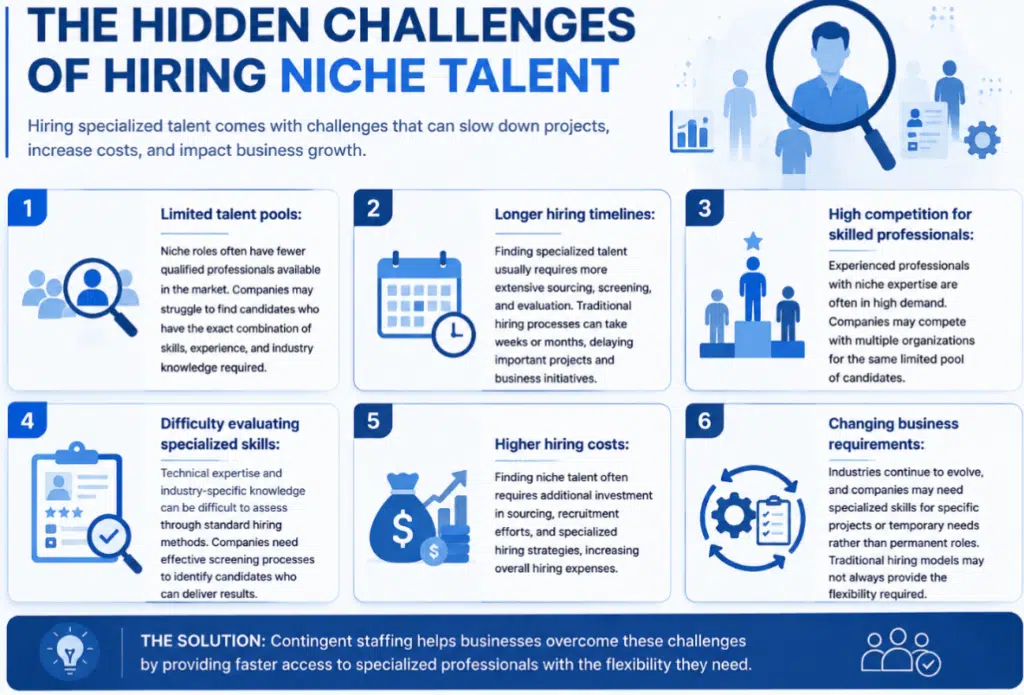
2. Why is hiring niche talent challenging for companies?
Niche industries often require professionals with specific technical skills, certifications, and industry experience. Limited talent pools, high competition, and longer hiring timelines can make it difficult for companies to find the right candidates through traditional hiring methods.
3. When should companies consider using contingent staffing?
Companies should consider contingent staffing when they need specialized skills quickly, require support for short-term projects, face changing workforce demands, or want flexibility without making long-term hiring commitments.
4. How does Denken Solutions help businesses overcome niche talent shortages?
Denken Solutions helps businesses access specialized professionals by understanding their workforce requirements and connecting them with qualified contingent talent. This enables companies to fill skill gaps faster and maintain workforce flexibility.
5. Why should companies choose Denken Solutions for contingent staffing?
Denken Solutions helps businesses simplify contingent hiring by providing access to qualified professionals, supporting the recruitment process, and helping organizations build flexible workforce strategies based on their changing needs.